
- Home
- Robert Silverberg
Stochastic Man Page 2
Stochastic Man Read online
Page 2
The guests! They were as promised, a spectacular swarm of contraltos and astronauts and quarterbacks and chairpersons of the board. Costumes ran to formal-flamboyant, with the expectable display of breasts and genitalia but also the first hints, from the avant-garde, of die fin-de-siècle love of concealment that now has taken over, high throats and tight bandeaus. Half a dozen of the men and several of the women affected clerical garb and there must have been fifteen pseudo generals bedecked with enough medals to shame an African dictator. I was dressed rather simply, I thought, in a pleatless radiation-green singlet and a three-strand bubble necklace. Though the rooms were crowded, the flow of the party was far from formless, for I saw eight or ten big swarthy outgoing men in subdued clothing, key members of Haig Mardikian’s ubiquitous Armenian mafia, distributed equidistantly through the main room like cribbage pegs, like goalposts, like pylons, each occupying a preassigned fixed position and efficiently offering smokes and drinks, making introductions, directing people toward other people whose acquaintance it might be desirable for them to make. I was drawn easily into this subtle gridwork, had my hand mangled by Ara Garabedian or Jason Komurjian or perhaps George Missakian, and found myself inserted into orbit on a collision course with a sunny-faced golden- haired woman named Autumn, who wasn’t Armenian and with whom I did in fact go home many hours later.
Long before Autumn and I came to that, though, I had been smoothly nudged through a long musical-chairs rotation of conversational partners, during the course of which I
—found myself talking to a female person who was black, witty, stunning-looking, and half a meter taller than I am, and whom I correctly guessed to be Ilene Mulamba, the head of Network Four, a meeting which led to my getting a fancy consulting contract for design of their split-signal ethnic-zone telecasts—
—gently deflected the playful advances of City Councilman Ronald Holbrecht, the self-styled Voice of the Gay Community and the first man outside California to win an election with Homophile Party endorsement—
—wandered into a conversation between two tall white-haired men who looked like bankers and discovered them to be bioenergetics specialists from Bellevue and Columbia-Presbyterian, swapping gossip about their current sonopuncture work, which involved ultrasonic treatment of advanced bone malignancies—
—listened to an executive from CBS Labs telling a goggle-eyed young man about their newly developed charisma-enhancement biofeedback-loop gadget—
—learned that the goggle-eyed young man was Lamont Friedman of the sinister and multifarious investment banking house of Asgard Equities—
—exchanged trifling chitchat with Nole Maclver of the Ganymede Expedition, Claude Parks of the Dope Patrol (who had brought his molecular sax, and didn’t need much encouragement to play it), three pro basketball stars and some luminous right-fielder, an organizer for the new civil-service prostitutes’ union, a municipal brothel inspector, an assortment of less trendy city officials, and the Brooklyn Museum’s curator of transient arts, Mei-ling Pulvermacher—
—had my first encounter with a Transit Creed proctor, the petite but forceful Ms. Catalina Yarber, just arrived from San Francisco, whose attempt to convert me on the spot I declined with oblique excuses—
—and met Paul Quinn.
Quinn, yes. Sometimes I wake quivering and perspiring from a dreamed replay of that party in which I see myself swept by an irresistible current through a sea of yammering celebrities toward the golden, smiling figure of Paul Quinn, who waits for me like Charybdis, eyes agleam, jaws agape. Quinn was thirty-four then, five years my senior, a short powerful-looking man, blond, broad shoulders, wide-set blue eyes, a warm smile, conservative clothes, a rough masculine handshake, grabbing you by the inside of your biceps as well as by your hand, making eye contact with an almost audible snap, establishing instant rapport All that was standard political technique, and I had seen it often enough before, but never with this degree of intensity and power. Quinn leaped across the person-person gap so quickly and so confidently that I began to suspect he must be wearing one of those CBS charisma-enhancement loops in his earlobe. Mardikian told him my name and right away he was into me with, “You’re one of the people I was most eager to meet here tonight,” and, “Call me Paul,” and, “Let’s go where it’s a little quieter, Lew,” and I knew I was being expertly conned and yet I was nailed despite myself.
He led me to a little salon a few rooms northwest of the main room. Pre-Columbian clay figurines, African masks, pulsar screens, splash stands—a nice mixture of old and new decorative notions. The wallpaper was New York Times, vintage 1980 or so. “Some party,” Quinn said, grinning. He ran quickly down the guest list, sharing with me a small-boy awe at being among such celebrities.
Then he narrowed the focus and moved in on me.
He had been well briefed. He knew all about me, where I had gone to school, what my degree was in, what sort of work I did, where my office was. He asked if I had brought my wife—”Sundara, isn’t that her name? Asian background?”
“Her family’s from India.”
“She’s said to be quite beautiful.”
“She’s in Oregon this month.”
“I hope I’ll get a chance to meet her. Perhaps next time I’m out Richmond way I’ll give you a call, yes? How do you like living on Staten Island, anyway?”
I had seen this before, too, the full Treatment, the politician’s computerized mind at work, as though a nugget of microcircuitry were going click-click-click in there whenever facts were needed, and for a moment I suspected he might be some sort of robot. But Quinn was too good to be unreal. On one level he was simply feeding back everything he had been told about me, and making an impressive performance of it, but on another level he was communicating his amusement at the outrageous excessiveness of his own con job, as though inwardly winking and telling me, I’ve got to pile it on, Lew, that’s the way I’m supposed to play this dumb game. Also he seemed to be picking up and reflecting the fact that I, too, was both amused and awed by his skill. He was good. He was frighteningly good. My mind went into automatic project and handed me a series of Times headlines that went something like this:
BRONX ASSEMBLYMAN QUINN
ATTACKS SLUM-CLEARANCE DELAYS
MAYOR QUINN CALLS FOR
CITY CHARTER REFORM
SENATOR QUINN SAYS
HE’LL SEEK WHITE HOUSE
QUINN LEADS NEW DEMOCRATS
TO NATIONWIDE LANDSLIDE
PRESIDENT QUINN’S FIRST TERM:
AN APPRAISAL
He went on talking, all the while smiling, maintaining eye contact, holding me impaled. He quizzed me about my profession, he pumped me for my political beliefs, he iterated his own. “They say you’ve got the best reliability index of any projector in the Northeast…. I’ll bet not even you anticipated the Gottfried assassination, though…. You don’t have to be much of a prophet to feel sorry for poor dopey DiLaurenzio, trying to run City Hall at a time like this…. This city can’t be governed, it has to be juggled…. Are you as repelled by that phony Neighborhood Authority Act as I am?... What do you think of Con Ed’s Twenty-third Street fusion project?... You ought to see the flow charts they found in Gottfried’s office safe….” Deftly he plumbed for common grounds in political philosophy, though he had to be aware I shared most of his beliefs, for if he knew so much about me he would know I was a registered New Democrat, that I had done the projections for the Twenty-first Century Manifesto and its companion, the book Toward a True Humanity, that I felt as he did about priorities and reforms and the whole inane Puritan idea of trying to legislate morality. The longer we spoke the more strongly I was drawn to him.
I began making quiet unsettling comparisons between Quinn and some great politicians of the past—FDR, Rockefeller, Johnson, the original Kennedy. They had all had that warm beautiful doublethink knack of being able to play out the rituals of political conquest and simultaneously to indicate to their more intelligent victims that nobody
’s being fooled, we all know it’s just a ritual, but don’t you think I’m good at it? Even then, even that first night in 1995, when he was just a kid assemblyman unknown outside his own borough, I saw him heading into political history alongside Roosevelt and JFK. Later I began making more grandiose comparisons, between Quinn and the likes of Napoleon, Alexander the Great, even Jesus, and if such talk makes you snicker, please remember that I am a master of the stochastic arts and my vision is clearer than yours.
Quinn said nothing to me then about running for higher office. As we returned to the party he simply remarked, “It’s too early for me to be setting up a staff. But when I do, I’ll want you. Haig will be in touch.”
“What did you think of him?” Mardikian asked me five minutes later.
“He’ll be mayor of New York City in 1998.”
“And then?”
“You want to know more, man, you get in touch with my office and make an appointment. Fifty an hour and I’ll give you the whole crystal-balling.”
He jabbed my arm lightly and strode away laughing.
Ten minutes after that I was sharing a pipe with the golden-haired lady named Autumn. Autumn Hawkes, she was, the much-hailed new Met soprano. Quickly we negotiated an agreement, eyes only, the silent language of the body, concerning the rest of the night. She told me she had come to the party with Victor Schott—gaunt gigantic youngish Prussian type in somber medal-studded military outfit—who was due to conduct her in Lulu that winter, but Schott had apparently arranged a deal to go home with Councilman Holbrecht, leaving Autumn to shift for herself. Autumn shifted. I was undeceived about her real preference, though, for I saw her looking hungrily at Paul Quinn far across the room, and her eyes glowed. Quinn was here on business: no woman could bag him. (No man either!) “I wonder if he sings,” Autumn said wistfully.
“You’d like to try some duets with him?”
“Isolde to his Tristan. Turandot to his Calaf. Aïda to his Radames.”
“Salome to his Jokanaan?” I suggested.
“Don’t tease.”
“You admire his political ideas?”
“I could, if I knew what they were.”
I said, “He’s liberal and sane.”
“Then I admire his political ideas. I also think he’s overpoweringly masculine and superbly beautiful.”
“Politicians on the make are said to be inadequate lovers.”
She shrugged. “Hearsay evidence never impresses me. I can look at a man—one glance will do—and know instantly whether he’s adequate.”
“Thank you,” I said.
“Save the compliments. Sometimes I’m wrong, of course,” she said, poisonously sweet “Not always, but sometimes.”
“Sometimes I am, too.”
“About women?”
“About anything. I have second sight, you know. The future is an open book to me.”
“You sound serious,” she said.
“I am. It’s the way I earn my living. Projections.”
“What do you see in my future?” she asked, half coy, half in earnest.
“Immediate or long range?”
“Either.”
“Immediate,” I said, “a night of wild revelry and a peaceful morning stroll in a light drizzle. Long range, triumph upon triumph, fame, a villa in Majorca, two divorces, happiness late in life.”
“Are you a Gypsy fortuneteller, then?”
I shook my head. “Merely a stochastic technician, milady.”
She glanced toward Quinn. “What do you see ahead for him?”
“Him? He’s going to be President. At the very least.”
7
In the morning, when we strolled hand in hand through the misty wooded groves of Securtiy Channel Six, it was drizzling. A cheap triumph: I tune in weather reports like anyone else. Autumn went off to rehearse, summer ended, Sundara came home exhausted and happy from Oregon, new clients picked my mind for lavish fees, and life went on.
There was no immediate follow-up to my meeting with Paul Quinn, but I hadn’t expected one. New York City’s political life was in wild flux just then. Only a few weeks before Sarkisian’s party a disgruntled jobseeker had approached Mayor Gottfried at a Liberal Party banquet and, removing the half-eaten grapefruit from the astounded mayor’s plate, had clapped a gram of Ascenseur, the new French political explosive, in its place. Exeunt His Honor, the assassin, four county chairmen, and a waiter, in one glorious boom. Which created a power vacuum in the city, for everyone had assumed the formidable mayor would be elected to another four or five terms, this being only his second, and suddenly the invincible .Gottfried wasn’t there, as though God had died one Sunday morning just as the cardinal was starting to serve the bread and wine. The new mayor, former City Council President DiLaurenzio, was a nonentity: Gottfried, like any true dictator, liked to surround himself with bland obliging ciphers. It was taken for granted that DiLaurenzio was an interim figure who could be pushed aside in the ‘97 mayoralty election by any reasonably strong candidate. And Quinn was waiting in the wings.
I heard nothing from or about him all fall. The Legislature was in session and Quinn was at his desk in Albany, which is like being on Mars so far as anybody in New York City cares. In the city the usual weird circus was going full blast, only more so than usual now that the potent Freudian force that was Mayor Gottfried, the Urban Allfather, dark of brow and long of nose, guardian of the weak and castrator of the unruly, had been removed from the scene. The 125th Street Militia, a new black self-determination force that had been boasting for months that it was buying tanks from Syria, not only unveiled three armored monsters at a noisy press conference but proceeded to send them across Columbus Avenue on a search-and-destroy mission into Hispano Manhattan, leaving four blocks in flames and dozens dead. In October, while the blacks were celebrating Marcus Garvey Day, the Puerto Ricans retaliated with a commando raid on Harlem, personally led by two of their three Israeli colonels. (The barrio boys had hired the Israelis to train their troops in ‘94, following the ratification of the anti-black “mutual defense” alliance put together by the Puerto Ricans and what was left of the city’s Jewish population.) The commandos, in a lightning strike up Lenox Avenue, not only blew up the tank garage and all three tanks, but took out five liquor stores and the main numbers computer center, while a diversionary force slipped westward to firebomb the Apollo Theater.
A few weeks later at the site of the West Twenty-third Street Fusion Plant there was a shootout between the profusion group, Keep Our Cities Bright, and the anti- fusionists, Concerned Citizens Against Uncontrollable Technology. Four Con Edison security men were lynched and there were thirty-two fatalities among the demonstrators, twenty-one KOCB and eleven CCAUT, including a lot of politically involved young mothers on both sides and even a few babes in arms; this caused much horror and outcry (even in New York you can stir strong emotions by gunning babies during a demonstration), and Mayor DiLaurenzio found it expedient to appoint a study group to re-examine the whole question of building fusion plants within city limits. Since this amounted to a victory for CCAUT, a KOCB strike-force blockaded City Hall and began planting protest mines in the shrubbery, but they were driven off by a police tac squad strafing ‘copter at a cost of nine more lives. The Times put the story on page 27.
Mayor DiLaurenzio, speaking from his Auxiliary City Hall somewhere in the East Bronx—he had set up seven offices in outlying boroughs, all in Italian neighborhoods, the exact locations being carefully guarded secrets— issued new lawnorder pleas. However, nobody in the city paid much attention to the mayor, partly because he was such a nebbish and partly as an overcompensating reaction to the removal of the brooding, sinister, overwhelming presence of Gottfried the Gauleiter. DiLaurenzio had staffed his administration, from police commissioner down to dogcatcher and clean-air administrator, with Italian cronies, which I suppose was reasonable enough, since the Italians were the only ones in town who showed any respect for him, and that merely because they
were all his cousins or nephews. But that meant that the mayor’s sole political support was drawn from an ethnic minority that grew more minor every day. (Even Little Italy was reduced to four blocks of Mulberry Street, with Chinese swarming on every side street and the new generation of paisanos holed up securely in Patchogue and New Rochelle.) An editorial in the Wall Street Journal suggested suspending the upcoming mayoralty election and placing New York City under a military administration, with a cordon sanitaire to keep infectious New Yorkism from contaminating the rest of the country.
“I think a UN peacekeeping force would be a better idea,” Sundara said. This was early December, the night of the season’s first blizzard. “This isn’t a city, it’s a staging ground for all the accumulated racial and ethnic hostilities of the last three thousand years.”
“That’s not so,” I told her. “Old grudges don’t mean crap here. Hindus sleep with Paks in New York, Turks and Armenians go into partnership and open restaurants. In this city we invent new ethnic hostilities. New York is nothing if it isn’t avant-garde. You’d understand that if you’d lived here all your life the way I have.”
“I feel as though I have.”
“Six years doesn’t make you a native.”
“Six years in the middle of constant guerrilla warfare feels longer than thirty years anywhere else,” she said.
 The Longest Way Home
 Hawksbill Station
 A Time of Changes
 This Way to the End Times: Classic Tales of the Apocalypse
 Beyond the Gate of Worlds
 Lord Valentine's Castle
 The Man in the Maze
 Tales of Majipoor
 Time of the Great Freeze
 The Collected Stories of Robert Silverberg, Volume 3: Something Wild Is Loose: 1969-72
 Planet of Death
 Trips: The Collected Stories of Robert Silverberg, Volume Four
 In the Beginning: Tales From the Pulp Era
 Hot Sky at Midnight
 Valentine Pontifex
 Up the Line
 Thorns
 Amanda and the Alien
 Star of Gypsies
 Nightwings
 The Time Hoppers
 Blood on the Mink
 Dying Inside
 The Last Song of Orpheus
 The King of Dreams
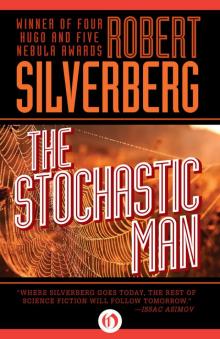 The Stochastic Man
 The Collected Stories of Robert Silverberg, Volume Seven: We Are for the Dark
 The Millennium Express: The Collected Stories of Robert Silverberg, Volume Nine
 The Iron Chancellor
 Lord Prestimion
 To Open the Sky
 The World Inside
 Chains of the Sea
 The Collected Stories of Robert Silverberg, Volume Five: The Palace at Midnight
 Postmark Ganymede
 The Second Trip
 The Collected Stories of Robert Silverberg, Volume 4: Trips: 1972-73
 Son of Man
 Tom O'Bedlam
 To the Land of the Living
 To Be Continued: The Collected Stories of Robert Silverberg, Volume One
 Shadrach in the Furnace
 The Chalice of Death: Three Novels of Mystery in Space
 The Queen of Springtime
 To Be Continued 1953-1958
 Legends
 Roma Eterna
 To Live Again
 At Winter's End
 Needle in a Timestack
 To Live Again and the Second Trip: The Complete Novels
 Lord of Darkness
 The Mountains of Majipoor
 The World Outside
 The Alien Years
 The Book of Skulls
 The Face of the Waters
 Gilgamesh the King
 The Collected Stories of Robert Silverberg, Volume 6: Multiples: 1983-87
 The Happy Unfortunate
 Three Survived
 Cronos
 Tower of Glass
 Legends II
 The Planet Killers
 The Collected Stories of Robert Silverberg, Volume 2: To the Dark Star: 1962-69
 Downward to the Earth
 Lord Valentine's Castle: Book One of the Majipoor Cycle
 Hot Times in Magma City, 1990-95
 Hunt the Space-Witch! Seven Adventures in Time and Space
 Majipoor Chronicles
 The Robert Silverberg Science Fiction Megapack(r)
 Starman's Quest
 Car Sinister
 Worlds of Maybe
 Fantasy The Best of 2001
 Revolt on Alpha C
 Homefaring
 The Pardoner's Tale
 Sailing to Byzantium - Six Novellas
 The Chalice of Death
 Sundance
 A Tip on a Turtle
 Nebula Awards Showcase 2001: The Year's Best SF and Fantasy Chosen by the Science Fiction and Fantasy Writers of America
 The Fangs of the Trees
 The Palace at Midnight: The Collected Work of Robert Silverberg, Volume Five
 The Millennium Express - 1995-2009 - The Collected Stories of Robert Silverberg Volume Nine
 Book of Skulls
 Passengers
 Something Wild is Loose - 1969–72 - The Collected Stories of Robert Silverberg Volume Three
 Multiples
 Starborne
 The Masks of Time
 The Mountains of Majipoor m-8
 Multiples (1983-87)
 Those Who Watch
 In the Beginning
 Earth Is The Strangest Planet
 Collision Course
 Neutral Planet
 To the Dark Star - 1962–69 - The Collected Stories of Robert Silverberg Volume Two
 Mutants
 Sailing to Byzantium
 When We Went to See the End of the World
 Robert Silverberg The Science Fiction Hall Of Fame Volume One, 1929-1964
 To Be Continued - 1953–58 - The Collected Stories of Robert Silverberg Volume One
 Valentine Pontifex m-3
 Gianni
 Majipoor Chronicles m-2
 We Are for the Dark (1987-90)
 Waiting for the Earthquake
 Fantasy: The Best of 2001
 How It Was When the Past Went Away
 Beauty in the Night
 The Man Who Never Forgot
 The Book of Changes m-9
 Lord Valentine's Castle m-1
 This Way to the End Times
 Queen of Springtime
 Legends-Volume 3 Stories by the Masters of Modern Fantasy
 The Palace at Midnight - 1980–82 - The Collected Stories of Robert Silverberg Volume Five
 Something Wild is Loose: The Collected Stories of Robert Silverberg, Volume Three
 Multiples - 1983–87 - The Collected Stories of Robert Silverberg Volume Six
 Alaree
 Three Survived: A Science Fiction Novel
 Defenders of the Frontier
 The New Springtime
 We Are for the Dark - 1987–90 - The Collected Stories of Robert Silverberg Volume Seven
 The Science Fiction Hall of Fame, Volume One 1929-1964--The Greatest Science Fiction Stories of All Time Chosen by the Members of the Science Fiction Writers of America
 Master Of Life And Death
 Choke Chain
 Sorcerers of Majipoor m-4
 Absolutely Inflexible
 Trips - 1962–73 - The Collected Stories of Robert Silverberg Volume Four
 Hot Times in Magma City - 1990-95 - The Collected Stories of Robert Silverberg Volume Eight
 Far Horizons
 The Queen of Springtime ns-2
 The Seventh Science Fiction Megapack
 Invaders From Earth
 Hanosz Prime Goes To Old Earth
 The Macauley Circuit
 Science Fiction: The Best of 2001
 To the Dark Star: The Collected Stories of Robert Silverberg, Volume Two
 Stochastic Man
 Legends: Stories By The Masters of Modern Fantasy
 To Live Again And The Second Trip
 Flies
Flies The Silent Invaders
 Ship-Sister, Star-Sister