
- Home
- Robert Silverberg
Chains of the Sea Page 3
Chains of the Sea Read online
Page 3
“They are a lot like my mollies,” said Paul tonelessly.
“Yes, of course,” said Moss, watching Paul uneasily, unwilling to agree that there might be some connection. “Of course, you purchased your original stock from us, but I don’t think we can be held responsible.”
“It’s certainly comforting to know that it isn’t just the little people who can be careless.” Moss frowned but did not answer. Paul shook his head, turned, and left the store.
The ride home was as crowded as the ride to the fish store had been. But, he told himself, now he had the rather sad consolation that Linda wouldn’t be able to mock him for buying several dollars’ worth of new mollies. Right after supper he would go into the bedroom and begin the arduous job of cleaning and sterilizing the tanks.
The meal with his wife passed silently, tensely. Linda had made spaghetti again, finding time in her long, lonely day only to boil water and warm a jar of commercial sauce. Paul was very angry; he came home to spaghetti at least three times a week. As soon as he had finished eating, Paul left the table and disappeared into the bedroom. Half an hour later Linda came in to see what he was doing.
“You taking all those sickening fish out of the tank now?” she asked.
Paul turned around slowly and regarded her for several seconds. “You want me to leave them here for you to look at?” he said quietly.
“Oh, don’t be like that,” she said, tossing a dish towel over her shoulder. “Just don’t drop any on the rug. And watch that you don’t splash that filthy water around my bedroom. Are you going to get rid of those tanks now?”
Paul turned back to his work. “Naw,” he muttered. “Going to get some more.”
“Huh?”
“I said I’m going to order some new mollies.”
“So they can die off, too, and waste more money?”
Paul scooped the last of the dead mollies from the large fifty- gallon tank. He picked up the pot that held the others and carried it into the kitchen. As he passed Linda, she backed away, a disgusted expression on her face. “Listen,” he said, dumping the fish into the garbage bag, “I went to the fish place after work. All of their mollies died last weekend, too. And I bought mine from them, so it can’t be my fault. Your trouble is you’re too quick to make me look like a fool. I’m not as dumb as you think I am.”
Linda went back to the sinkful of dishes. “Just take that garbage downstairs before you do anything else. Use some common sense, for heaven’s sake.”
That night, when the large tank and the step-breeder stood empty and clean, after the filters and air lines had been washed and sterilized, Paul decided to order some breeding stock from a supplier in Connecticut. He wrote a letter, asking the price for ten females and four males. Several days later he received a reply, and the situation took a stranger shape. The letter said:
We here at G & G appreciate your interest, but regret to say that your order cannot be filled at this time. Our entire stock of Mollienisia sphenops perished early this week, and we have been unable to receive replacements from our usual sources. I would normally suggest that you try our competitors, but curiously they have all experienced the same misfortune.
Hoping to be of more service in the future, I remain,
Very truly yours,
Walter G. Gretne G & G Aquarium Supply
Paul was confused. It was as if somebody were making it hard for him to refill his tanks. Linda would say that they were trying to tell him something. But Linda only believed in fate or God when something bad happened to someone she knew. He decided not to mention the letter at all and, in fact, to seem to forget all about mollies until he could locate a source of healthy fish.
The next day, Sunday, he ignored Linda’s pointed questions about all the expensive equipment going to waste in the bedroom. He didn’t want to think about it. It was his weekend, and he wanted to relax. The Sunday paper was split up all over the house. Paul had the baseball news with him in the bathroom. The remaining sections were divided among the other rooms, and Linda had the television section with her in the bedroom. When Paul had finished with the sports, he stuck his head around the comer of the bedroom. “You got the movie section in here?”
Linda lay on the bed, the tiny portable television next to her. She was listening to an old Alan Ladd film while she read the paper.
“Yeah,” she said, “but I’m going to look at it next. You can have the TV section.”
“I don’t want the TV section,” he said impatiently.
“There’s something in it that might interest you.” She pulled the first and last pages off the section, further separating the newspaper. She handed the sheet to Paul. “Something about your stupid fish,” she said.
Paul searched the pages for the article she meant. At last he found it, a small piece several lines long, stuck in as a filler at the foot of a column. It said, rather tersely, that scientists had noted that no members of the species Mollienisia sphenops could be found alive in the United States, or even at their natural breeding grounds in the waters around the Yucatan Peninsula and Guatemala. The paper said that the scientists were puzzled.
The next few days were among the most bewildering of my somewhat eventful life. The situation certainly appeared simple enough on the surface: my mollies had died, I had to get new ones, and I had difficulty locating healthy specimens in Cleveland. At first Dr. Johnson took little more than amused interest in my problem. You must remember that at this time we had no idea of the magnitude of the circumstances; we were ignorantly working away on our mice and rabbits, frogs and flies. We gave no thought for anything more serious than the weekly party with our colleagues or our lapsed subscriptions to various scientific journals. Often we went down to watch the sun set over the river or rise over the lake, while around us the universe prepared its next terrible blow.
The day after the mollies died, Monday, I was busy all afternoon helping Dr. Johnson construct a towering, brittle web work of glassware. It was supported by heavy black iron stands at critical points. Flasks were the major component, a strong, optimistic theme that was typical of my friend. Connecting them were dozens and dozens of long glass arteries. Where some members of the scientific community in Cleveland would, I’m sure, have been satisfied to remain with the straight, purely functional tubes, Dr. Johnson did not hesitate to introduce long, delicate bends or even rude petcocks. The levels at which the flasks stood were pleasingly random, another nontechnical touch that made Dr. Johnson’s creations superior to those of his contemporaries. Certain obscure, baroquely contorted pieces of glassware punctuated the whole structure, adding definite statements of progress and enterprise among the soothing chords. As a minor helper to the construction, I could only watch with amazement and respect as Dr. Johnson added one faultless detail after another.
By evening the thing was completed. Dr. Johnson ceremoniously made each of us a champagne cocktail, and we toasted his new work. Then I snapped the switch, killing the lights in the auxiliary lab; meanwhile Dr. Johnson had moved to his new parvum opus. He connected a plug from a strange piece of apparatus to a long extension cord. A bright-blue spark began to flick among the towers and tiny catwalks of glass. The eerie light cast hideous shadows in the room, and I was seized with a new, almost unpleasant awe for Dr. Johnson and his creative faculties. But no sooner had I begun to creep forward for a better view than he turned the lights back on in the room. “Enough,” he said, waving his hand impatiently. “It does not work.”
“It’s beautiful!” I said, dismayed by the fury of his passion.
“It is not,” he said. “It is clumsy. Lopsided, imbalanced. Tomorrow I will destroy it.”
“You can’t, my friend,” I said, genuinely horrified. “You’re too critical of your achievements.”
He studied me for a few seconds, his expression contorted by emotions I fear I shall never experience. “What can you know of an artist’s pain?” he asked. He was right, of course; in t
he morning I helped him destroy it.
His problems, his creative agonizing helped me to forget my own meager troubles. Monday had sped by with the assembling of his glass masterpiece; Tuesday saw its slow, tedious dismantling. I was greatly fatigued that night, as it was I who had to climb high to loosen flasks and tubes and Fleischer retorts. Dr. Johnson preferred to stand by and direct me; I did not think he was remiss in not helping me more actively. I recognized that he was, in his peculiar way, a genius; people of that caliber are entitled to a few eccentricities.
So, then, it was Wednesday before I was able to get around to calling at the few remaining pet stores in the Cleveland area. I tried one on Melpomene Street first of all, because that store had always given us a good deal on shredded lettuce and dead mice, food for various laboratory animals. Old Miss Fry told me tearfully that all her black mollies had died Sunday, too. I remarked on the sad coincidence, and how cheap it seemed of nature to merely duplicate her efforts in our separate aquariums. Miss Fry looked at me blankly, not comprehending my romantic notion, and I explained that I thought that possibly “something was going around.” She laughed, and I tried another store. This one, on Terpsichore Street, not far from Miss Fry’s, had abominable-quality fish but very nice “extras.” I had spent a good deal of our budget on such things as marbles, painted glass bridges for the catfish to rest under, bubbling skin divers, bubbling sunken wrecks, bubbling treasure chests, and bubbling mermaids. I had even purchased as a joke a couple of dozen plastic fish; these had thin, almost invisible strings with weights tied to the ends. I buried the weights in the sand of one aquarium, and the fish hung suspended, always at one place. Though they never moved, I don’t believe Dr. Johnson ever noticed that they weren’t real fish. He didn’t take to my pets as much as I; I think he even resented the amount of money I spent to keep them happy.
Anyway, I was told in the second shop that all their mollies had died the previous Sunday. I felt a peculiar thrill of fear. I had often felt that thrill before, and so I was not particularly interested now. But I thought that Dr. Johnson, at least, and possibly the entire scientific community might be intrigued by this gloomy turn of events. There might even be a project worth pursuing by some crew-cut statistician.
I followed St. Charles farther toward the downtown area, hitting all the pet shops I knew. In each, the story was the same: every black molly in Cleveland had died spontaneously, sometime Sunday afternoon. I was becoming increasingly tired, as well as fascinated by the latent horror of the situation. I decided to try one last place, a dirty establishment in the Quarter. I rarely had occasion to travel into that neighborhood, because its residents were some of the more lunatic of the city’s population, all entirely overcome by the old disaster of several years ago. But I had little choice now; my scientific curiosity, sluggish to arouse at best, was now at last piqued and would not allow me to halt before some slight explanation might be had. I thought immediately of a virus, but dismissed the idea as unworthy.
I entered the sordid little shop unenthusiastically. The owner, one Mr. de Crout, hurried to meet me at the door.
“Have you any mollies?” I asked, wasting little time.
“No, they’re all dead,” he said, turning to retrace his steps to the back of the store and his small television.
I took the St. Charles streetcar home and told Dr. Johnson all about my day’s adventure. As I foresaw, he was deeply concerned. From that time on he assumed control of the investigation, leaving me with a good deal of time to practice my own glassware sculpture. I had at last built something that I felt approached his own triumph of Monday, when he burst into the room, his face flushed and his lab coat tom at one shoulder. He seemed not to notice.
“I have news!” he cried.
“Look at this,” I said.
“Never mind, we don’t have time for such as that. Every molly in the city has been accounted for, and they’re all dead. Every molly in the country is dead as well; I have proof.” Here he waved a sheaf of telegrams. Each one was a molly count of a particular segment of the United States. Dr. Johnson had organized the fact-finding operation well. His efficient handling of the matter made me see him in a new light; he was, beyond doubt, my superior in such things. “Further,” he said, his voice rising to unaccustomed levels of pitch and volume, “there is not to be found a single living molly in all of the coastal waters of the Yucatan or Guatemala, or the Gulf of Mexico, or Florida, their natural breeding grounds.”
I stared at him. The thing was monstrous. “What do you make of it?” I asked.
“What else?” he asked, throwing the papers at me impatiently. I laughed with delight. “The species is done for,” he said, pacing agitatedly. “I believe that an entire variety of animal life has become extinct, within the unbelievably short time span of a single day.”
“Do you know what you suggest?” I said, with the necessary scientific skepticism.
“Yes,” he said tiredly. “The world will think me mad, but I have done my duty.”
“You mean—”
“I have informed the newspapers.”
Then he was serious. I considered the problem for a moment. Before I could begin to sort my thoughts, I got the old familiar tingle: disaster! I smelled a disaster brewing, but it was too early to dig up more facts. I would have to wait.
“Sorry, old friend,” he said, jerking me from my reveries with a slap on the shoulder. “I know those little buggers meant the world to you. You’ll just have to get on without them. Switch your allegiance, as it were. Why not guppies, eh? Or something else altogether. Get out of the fish line.” I could see that he was right. I said nothing, though, letting him feel sorry for me. I turned and took up my sculpture where I had stopped.
An hour later he came running into the room all over again. This time I truthfully saw tears on his cheeks, the only time I have known him to weep alone. “They’re dead!” he whispered hoarsely. “All of them! Dead!”
“I know,” I said with some irritation.
“No, you don’t understand,” he said, grabbing the sleeve of my lab coat. “My beautiful pets! They’re all dead!”
Well, now, I remember thinking that at last I’d get to see his pets, which he had so carefully guarded from the view of the world at large. Even I had never seen them; I did not know so much as what they were, except dead. Now my instinctive tingle let me know: a new and perilous phase was beginning.
There was a great movie on at eleven thirty. The paper gave it only two stars; Paul had seen the film in a theater when it first came out, and he remembered that it was much better than that. The movie was one of Philip Gatelin’s last, and Linda had never been one of his fans. She wanted to watch one of the talk shows. But finally she sighed loudly, admitting defeat and accepting the lesser comforts of martyrdom. Paul changed the channel; the news was still on.
“Move that over, will you?” said Linda, pushing the small television set toward her husband. “Maybe I’ll just go to sleep.”
“Why don’t you do that?” asked Paul. “At least shut up.”
“Shut up yourself. I want to hear the weather.”
Before the local weather report, however, they had to watch a filmed interview prepared by the network. This spot, near the end of the newscast, was usually reserved for the day’s absurd happenings, or for quick glimpses of the nation’s crazier citizens. It was obviously in this spirit that the network newsman had been sent on his assignment.
“Hello,” he said, “this is Bob Dunne, NBC News in Romisch, Iowa. I’m standing outside the Pany Institute of Wentell Agricultural College. With me is Dr. Kyril Levy, head of the Institute and an expert in pharmacological botany. Dr. Levy has made a rather startling discovery but, like many of his scientific predecessors, he’s having a difficult time convincing his colleagues. But I’ll let him describe his findings himself. Dr. Levy, just what is happening here in peaceful Romisch?”
Levy was short and gaunt, middle-a
ged, his hair thinning prematurely, his stooped shoulders accentuated by the rumpled white lab coat he wore. He took a deep breath and began. “It’s not just here in Romisch, Bob. That’s the point of the whole matter. No, we’re all faced with the same problem, every one of us here in the United States and abroad.”
Dunne didn’t get any information at all with his first question. He tried again. “Could you summarize that problem for our viewers?”
“Certainly, Bob. My primary experiments here at the Institute concern the applications of dexterity equivalencies in the production of larger-yield money crops. For my purposes, I’ve been using a certain type of fungus. The experiments are general enough so that the results may be extended to include most other common money crops; the fungus has the added advantage of economy of cultivating area and growing season. The fungus, called by its Latin name, Polyporus gugliemii, is a pinkish-white, leathery growth that is found only on the trunks and limbs of a particular kind of Spanish catalpa.
“My experiments were coming along well, and last week I had reached what I estimated to be the midpoint of the program. So you can imagine how disappointed I was when I learned that every single gugliemii had died in the space of eighteen hours.”
Dunne regained the initiative, looking into the camera with an amused but patient expression. He was humoring the scientist for the sake of a few laughs. “I can imagine that would be a horrible sight,” he said.
“Yes, indeed,” said Levy. “When they die, their stalks go limp. The weight of the huge caps bends them over. Gugliemii are very bright orange on the underside, you know, with dark brown speckles. Well, it was just awful. All those poor orange corpses staring at me.”
“And did you try to replace them?”
“Of course. I called one of my colleagues in Wachnough immediately. I had introduced him to the gugliemii at last year’s convention. Anyway, he said that all of his had died under the same inexplicable circumstances.”
 The Longest Way Home
 Hawksbill Station
 A Time of Changes
 This Way to the End Times: Classic Tales of the Apocalypse
 Beyond the Gate of Worlds
 Lord Valentine's Castle
 The Man in the Maze
 Tales of Majipoor
 Time of the Great Freeze
 The Collected Stories of Robert Silverberg, Volume 3: Something Wild Is Loose: 1969-72
 Planet of Death
 Trips: The Collected Stories of Robert Silverberg, Volume Four
 In the Beginning: Tales From the Pulp Era
 Hot Sky at Midnight
 Valentine Pontifex
 Up the Line
 Thorns
 Amanda and the Alien
 Star of Gypsies
 Nightwings
 The Time Hoppers
 Blood on the Mink
 Dying Inside
 The Last Song of Orpheus
 The King of Dreams
 The Stochastic Man
 The Collected Stories of Robert Silverberg, Volume Seven: We Are for the Dark
 The Millennium Express: The Collected Stories of Robert Silverberg, Volume Nine
 The Iron Chancellor
 Lord Prestimion
 To Open the Sky
 The World Inside
 Chains of the Sea
 The Collected Stories of Robert Silverberg, Volume Five: The Palace at Midnight
 Postmark Ganymede
 The Second Trip
 The Collected Stories of Robert Silverberg, Volume 4: Trips: 1972-73
 Son of Man
 Tom O'Bedlam
 To the Land of the Living
 To Be Continued: The Collected Stories of Robert Silverberg, Volume One
 Shadrach in the Furnace
 The Chalice of Death: Three Novels of Mystery in Space
 The Queen of Springtime
 To Be Continued 1953-1958
 Legends
 Roma Eterna
 To Live Again
 At Winter's End
 Needle in a Timestack
 To Live Again and the Second Trip: The Complete Novels
 Lord of Darkness
 The Mountains of Majipoor
 The World Outside
 The Alien Years
 The Book of Skulls
 The Face of the Waters
 Gilgamesh the King
 The Collected Stories of Robert Silverberg, Volume 6: Multiples: 1983-87
 The Happy Unfortunate
 Three Survived
 Cronos
 Tower of Glass
 Legends II
 The Planet Killers
 The Collected Stories of Robert Silverberg, Volume 2: To the Dark Star: 1962-69
 Downward to the Earth
 Lord Valentine's Castle: Book One of the Majipoor Cycle
 Hot Times in Magma City, 1990-95
 Hunt the Space-Witch! Seven Adventures in Time and Space
 Majipoor Chronicles
 The Robert Silverberg Science Fiction Megapack(r)
 Starman's Quest
 Car Sinister
 Worlds of Maybe
 Fantasy The Best of 2001
 Revolt on Alpha C
 Homefaring
 The Pardoner's Tale
 Sailing to Byzantium - Six Novellas
 The Chalice of Death
 Sundance
 A Tip on a Turtle
 Nebula Awards Showcase 2001: The Year's Best SF and Fantasy Chosen by the Science Fiction and Fantasy Writers of America
 The Fangs of the Trees
 The Palace at Midnight: The Collected Work of Robert Silverberg, Volume Five
 The Millennium Express - 1995-2009 - The Collected Stories of Robert Silverberg Volume Nine
 Book of Skulls
 Passengers
 Something Wild is Loose - 1969–72 - The Collected Stories of Robert Silverberg Volume Three
 Multiples
 Starborne
 The Masks of Time
 The Mountains of Majipoor m-8
 Multiples (1983-87)
 Those Who Watch
 In the Beginning
 Earth Is The Strangest Planet
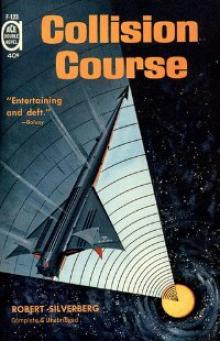 Collision Course
 Neutral Planet
 To the Dark Star - 1962–69 - The Collected Stories of Robert Silverberg Volume Two
 Mutants
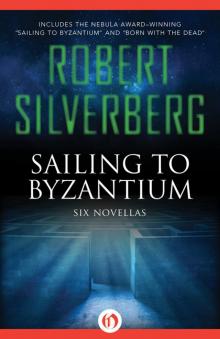 Sailing to Byzantium
 When We Went to See the End of the World
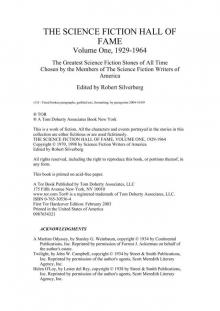 Robert Silverberg The Science Fiction Hall Of Fame Volume One, 1929-1964
 To Be Continued - 1953–58 - The Collected Stories of Robert Silverberg Volume One
 Valentine Pontifex m-3
 Gianni
 Majipoor Chronicles m-2
 We Are for the Dark (1987-90)
 Waiting for the Earthquake
 Fantasy: The Best of 2001
 How It Was When the Past Went Away
 Beauty in the Night
 The Man Who Never Forgot
 The Book of Changes m-9
 Lord Valentine's Castle m-1
 This Way to the End Times
 Queen of Springtime
 Legends-Volume 3 Stories by the Masters of Modern Fantasy
 The Palace at Midnight - 1980–82 - The Collected Stories of Robert Silverberg Volume Five
 Something Wild is Loose: The Collected Stories of Robert Silverberg, Volume Three
 Multiples - 1983–87 - The Collected Stories of Robert Silverberg Volume Six
 Alaree
 Three Survived: A Science Fiction Novel
 Defenders of the Frontier
 The New Springtime
 We Are for the Dark - 1987–90 - The Collected Stories of Robert Silverberg Volume Seven
 The Science Fiction Hall of Fame, Volume One 1929-1964--The Greatest Science Fiction Stories of All Time Chosen by the Members of the Science Fiction Writers of America
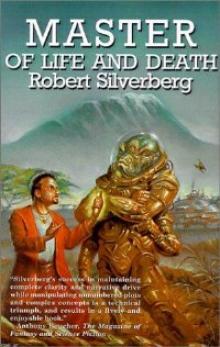 Master Of Life And Death
 Choke Chain
 Sorcerers of Majipoor m-4
 Absolutely Inflexible
 Trips - 1962–73 - The Collected Stories of Robert Silverberg Volume Four
 Hot Times in Magma City - 1990-95 - The Collected Stories of Robert Silverberg Volume Eight
 Far Horizons
 The Queen of Springtime ns-2
 The Seventh Science Fiction Megapack
 Invaders From Earth
 Hanosz Prime Goes To Old Earth
 The Macauley Circuit
 Science Fiction: The Best of 2001
 To the Dark Star: The Collected Stories of Robert Silverberg, Volume Two
 Stochastic Man
 Legends: Stories By The Masters of Modern Fantasy
 To Live Again And The Second Trip
 Flies
Flies The Silent Invaders
 Ship-Sister, Star-Sister