
- Home
- Robert Silverberg
Robert Silverberg The Science Fiction Hall Of Fame Volume One, 1929-1964 Page 5
Robert Silverberg The Science Fiction Hall Of Fame Volume One, 1929-1964 Read online
Page 5
"What did he claim, Jim? Prospector who couldn't find land to prospect?"
"That's not very funny, Bart. No; it wasn't only what he claimed. He didn't even claim it, just said it. You know, he didn't say it was true, he just said it. That's what gets me, I know it ain't true, but the way he said it—Oh, I don't know."
By which I knew he didn't. Jim Bendell's usually pretty careful about his English—real proud of it. When he slips, that means he's disturbed. Like the time he thought the rattlesnake was a stick of wood and wanted to put it on the fire.
Jim went on: And he had funny clothes, too. They looked like silver, but they were soft as silk. And at night they glowed just a little.
I picked him up about dusk. Really picked him up. He was lying off about ten feet from the South Road. I thought, at first, somebody had hit him, and then hadn't stopped. Didn't see him very clearly, you know. I picked him up, put him in the car, and started on. I had about three hundred miles to go, but I thought I could drop him at Warren Spring with Doc Vance. But he came to in about five minutes, and opened his eyes. He looked straight off, and he looked first at the car, then at the Moon.
"Thank God!" he says, and then looks at me. It gave me a shock. He was beautiful.
No; he was handsome.
He wasn't either one. He was magnificent. He was about six feet two, I think, and his hair was brown, with a touch of red-gold. It seemed like fine copper wire that's turned brown. It was crisp and curly. His forehead was wide, twice as wide as mine.
His features were delicate, but tremendously impressive; his eyes were gray, like etched iron, and bigger than mine—a lot.
That suit he wore—it was more like a bathing suit with pajama trousers. His arms were long and muscled smoothly as an Indian's. He was white, though, tanned lightly with a golden, rather than a brown, tan.
But he was magnificent. Most wonderful man I ever saw. I don't know, damn it!
"Hello!" I said. "Have an accident?"
"No; not this time, at least."
And his voice was magnificent, too. It wasn't an ordinary voice. It sounded like an organ talking, only it was human.
"But maybe my mind isn't quite steady yet. I tried an experiment. Tell me what the date is, year and all, and let me see," he went on.
"Why—December 9, 1932," I said.
And it didn't please him. He didn't like it a bit. But the wry grin that came over his face gave way to a chuckle.
"Over a thousand—" he says reminiscently. "Not as bad as seven million. I shouldn't complain."
"Seven million what?"
"Years," he said, steadily enough. Like he meant it. "I tried an experiment once.
Or I will try it. Now I'll have to try again. The experiment was—in 3059. I'd just finished the release experiment. Testing space then. Time—it wasn't that, I still believe. It was space. I felt myself caught in that field, but I couldn't pull away. Field gamma-H
481, intensity 935 in the Pellman range. It sucked me in, and I went out.
"I think it took a short cut through space to the position the solar system will occupy. Through a higher dimension, effecting a speed exceeding light and throwing me into the future plane."
He wasn't telling me, you know. He was just thinking out loud. Then he began to realize I was there.
"I couldn't read their instruments, seven million years of evolution changed everything. So I overshot my mark a little coming back. I belong in 3059."
"But tell me, what's the latest scientific invention of this year?"
He startled me so, I answered almost before I thought.
"Why, television, I guess. And radio and airplanes."
"Radio—good. They will have instruments."
"But see here—who are you?"
"Ah—I'm sorry. I forgot," he replied in that organ voice of his. "I am Ares Sen Kenlin. And you?"
"James Waters Bendell."
"Waters—what does that mean? I do not recognize it."
"Why—it's a name, of course. Why should you recognize it?"
"I see—you have not the classification, then. 'Sen' stands for science."
"Where did you come from, Mr. Kenlin?"
"Come from?" He smiled, and his voice was slow and soft. "I came out of space across seven million years or more. They had lost count— the men had. The machines had eliminated the unneeded service. They didn't know what year it was.
But before that—my home is in Neva'th City in the 3059."
That's when I began to think he was a nut.
"I was an experimenter," he went on. "Science, as I have said. My father was a scientist, too, but in human genetics. I myself am an experiment. He proved his point, and all the world followed suit. I was the first of the new race.
"The new race—oh, holy destiny—what has—what will—
"What is its end? I have seen it—almost. I saw them—the little men—
bewildered—lost. And the machines. Must it be—can't anything sway it?
"Listen—I heard this song."
He sang the song. Then he didn't have to tell me about the people. I knew them. I could hear their voices, in the queer, crackling, un-English words. I could read their bewildered longings. It was in a minor key, I think. It called, it called and asked, and hunted hopelessly. And over it all the steady rumble and whine of the unknown, forgotten machines.
The machines that couldn't stop, because they had been started, and the little men had forgotten how to stop them, or even what they were for, looking at them and listening—and wondering. They couldn't read or write any more, and the language had changed, you see, so that the phonic records of their ancestors meant nothing to them.
But that song went on, and they wondered. And they looked out across space and they saw the warm, friendly stars—too far away. Nine planets they knew and inhabited. And locked by infinite distance, they couldn't see another race, a new life.
And through it all—two things. The machines. Bewildered forgetfulness. And maybe one more. Why?
That was the song, and it made me cold. It shouldn't be sung around people of today. It almost killed something. It seemed to kill hope. After that song—I—well, I believed him.
When he finished the song, he didn't talk for a while. Then he sort of shook himself.
You won't understand (he continued). Not yet—but I have seen them. They stand about, little misshapen men with huge heads. But their heads contain only brains.
They had machines that could think—but somebody turned them off a long time ago, and no one knew how to start them again. That was the trouble with them. They had wonderful brains. Far better than yours or mine. But it must have been millions of years ago when they were turned off, too, and they just haven't thought since then.
Kindly little people. That was all they knew.
When I slipped into that field it grabbed me like a gravitational field whirling a space transport down to a planet. It sucked me in—and through. Only the other side must have been seven million years in the future. That's where I was. It must have been in exactly the same spot on Earth's surface, but I never knew why.
It was night then, and I saw the city a little way off. The Moon was shining on it, and the whole scene looked wrong. You see, in seven million years, men had done a lot with the positions of the planetary bodies, what with moving space liners, clearing lanes through the asteroids, and such. And seven million years is long enough for natural things to change positions a little. The Moon must have been fifty thousand miles farther out. And it was rotating on its axis. I lay there a while and watched it.
Even the stars were different.
There were ships going out of the city. Back and forth, like things sliding along a wire, but there was only a wire of force, of course. Part °f Ac city, the lower part, was brightly lighted with what must have teen mercury vapor glow, I decided. Blue-green.
I felt sure men didn't
We thwe—the light was wrong for eyes. But the top of the city w
as so sparsely lighted.
Then I saw something coming down out of the sky. It was brightly lighted. A huge globe, and it sank straight to the center of the great black-and-silver mass of the city.
I don't know what it was, but even then I knew the city was deserted. Strange that I could even imagine that, I who had never seen a deserted city before. But I walked the fifteen miles over to it and entered it. There were machines going about the streets, repair machines, you know. They couldn't understand that the city didn't need to go on functioning, so they were still working. I found a taxi machine that seemed fairly familiar. It had a manual control that I could work.
I don't know how long that city had been deserted. Some of the men from the other cities said it was a hundred and fifty thousand years. Some went as high as three hundred thousand years. Three hundred thousand years since human foot had been in that city. The taxi machine was in perfect condition, functioned at once. It was clean, and the city was clean and orderly. I saw a restaurant and I was hungry. Hungrier still for humans to speak to. There were none, of course, but I didn't know.
The restaurant had the food displayed directly, and I made a choice. The food was three hundred thousand years old, I suppose. I didn't know, and the machines that served it to me didn't care, for they made things synthetically, you see, and perfectly.
When the builders made those cities, they forgot one thing. They didn't realize that things shouldn't go on forever.
It took me six months to make my apparatus. And near the end I was ready to go; and, from seeing those machines go blindly, perfectly, on in orbits of their duties with the tireless, ceaseless perfection their designers had incorporated in them, long after those designers and their sons, and their sons' sons had no use for them—
When Earth is cold, and the Sun has died out, those machines will go on. When Earth begins to crack and break, those perfect, ceaseless machines will try to repair her—
I left the restaurant and cruised about the city in the taxi. The machine had a little, electric-power motor, I believe, but it gained its power from the great central power radiator. I knew before long that I was far in the future. The city was divided into two sections, a section of many strata where machines functioned smoothly, save for a deep humming beat that echoed through the whole city like a vast unending song of power. The entire metal framework of the place echoed with it, transmitted it, hummed with it. But it was soft and restful, a reassuring beat.
There must have been thirty levels above ground, and twenty more below, a solid block of metal walls and metal floors and metal and glass and force machines. The only light was the blue-green glow of the mercury vapor arcs. The light of mercury vapor is rich in high-energy- quanta, which stimulate the alkali metal atoms to photo-electric activity. Or perhaps that is beyond the science of your day? I have forgotten.
But they had used that light because many of their worker machines needed sight.
The machines were marvelous. For five hours I wandered through the vast power plant on the very lowest level, watching them, and because there was motion, and that pseudo-mechanical life, I felt less alone.
The generators I saw were a development of the release I had discovered —when?
The release of the energy of matter, I mean, and I knew when I saw that for what countless ages they could continue.
The entire lower block of the city was given over to the machines. Thousands. But most of them seemed idle, or, at most, running under light load. I recognized a telephone apparatus, and not a single signal came through. There was no life in the city. Yet when I pressed a little stud beside the screen on one side of the room, the machine began working instantly. It was ready. Only no one needed it any more. The men knew how to die, and be dead, but the machines didn't.
Finally I went up to the top of the city, the upper level. It was a paradise.
There were shrubs and trees and parks, glowing in the soft light that they had learned to make in the very air. They had learned it five million years or more before.
Two million years ago they forgot. But the machines didn't, and they were still making it. It hung in the air, soft, silvery light, slightly rosy, and the gardens were shadowy with it. There were no machines here now, but I knew that in daylight they must come out and work on these gardens, keeping them a paradise for masters who had died, and stopped moving, as they could not.
In the desert outside the city it had been cool, and very dry. Here the air was soft, warm and sweet with the scent of blooms that men had spent several hundreds of thousands of years perfecting.
Then somewhere music began. It began in the air, and spread softly through it.
The Moon was just setting now, and as it set, the rosy-silver glow waned and the music grew stronger.
It came from everywhere and from nowhere. It was within me. I do not know how they did it. And I do not know how such music could be written.
Savages make music too simple to be beautiful, but it is stirring.
Semisavages write music beautifully simple, and simply beautiful. Your Negro music was your best. They knew music when they heard it and sang it as they felt it.
Semicivilized peoples write great music. They are proud of their music, and make sure it is known for great music. They make it so great it is top-heavy.
I had always thought our music good. But that which came through the air was the song of triumph, sung by a mature race, the race of man in its full triumph! It was man singing his triumph in majestic sound that swept me up; it showed me what lay before me; it carried me on.
And it died in the air as I looked at the deserted city. The machines should have forgotten that song. Their masters had, long before.
I came to what must have been one of their homes; it was a dimly- seen doorway in the dusky light, but as I stepped up to it, the lights which had not functioned in three hundred thousand years illuminated it for me with a green-white glow, like a firefly, and I stepped into the room beyond. Instantly something happened to the air in the doorway behind me; it was as opaque as milk. The room in which I stood was a room of metal and stone. The stone was some jet-black substance with the finish of velvet, and the metals were silver and gold. There was a rug on the floor, a rug of just such material as I am wearing now, but thicker and softer. There were divans about the room, low and covered with these soft metallic materials. They were black and gold and silver, too.
I had never seen anything like that. I never shall again, I suppose, and my language and yours were not made to describe it.
The builders of that city had right and reason to sing that song of sweeping triumph, triumph that swept them over the nine planets and the fifteen habitable moons.
But they weren't there any more, and I wanted to leave. I thought of a plan and went to a subtelephone office to examine a map I had seen. The old World looked much the same. Seven or even seventy million years don't mean much to old Mother Earth. She may even succeed in wearing down those marvellous machine cities. She can wait a hundred million or a thousand million years before she is beaten.
I tried calling different city centers shown on the map. I had quickly learned the system when I examined the central apparatus.
I tried once—twice—thrice—a round dozen times. Yawk City, Lunon City, Paree, Shkago, Singpor, others. I was beginning to feel that there were no more men on all earth. And I felt crushed, as at each city the machines replied and did my bidding. The machines were there in each of those far vaster cities, for I was in the Neva City of their time. A small city. Yawk City was more than eight hundred kilometers in diameter.
In each city I had tried several numbers. Then I tried San Frisco. There was some one there, and a voice answered and the picture of a human appeared on the little glowing screen. I could see him start and stare in surprise at me. Then he started speaking to me. I couldn't understand, of course. I can understand your speech, and you mine, because your speech of this day is largely recorded on records of various type
s and has influenced our pronunciation.
Some things are changed; names of cities, particularly, because names of cities are apt to be polysyllabic, and used a great deal. People tend to elide them, shorten them.
I am in—Nee-vah-dah—as you would say? We say only Neva. And Yawk State. But it is Ohio and Iowa still. Over a thousand years, effects were small on words, because they were recorded.
But seven million years had passed, and the men had forgotten the old records, used them less as time went on, and their speech varied till the time came when they could no longer understand the records. They were not written any more, of course.
Some men must have arisen occasionally among that last of the race and sought for knowledge, but it was denied them. An ancient writing can be translated if some basic rule is found. An ancient voice though— and when the race has forgotten the laws of science and the labor of mind.
So his speech was strange to me as he answered over that circuit. His voice was high in pitch, his words liquid, his tones sweet. It was almost a song as he spoke. He was excited and called others. I could not understand them, but I knew where they were. I could go to them.
So I went down from the paradise of gardens, and as I prepared to leave, I saw dawn in the sky. The strange-bright stars winked and twinkled and faded. Only one bright rising star was familiar—Venus. She shone golden now. Finally, as I stood watching for the first time that strange heaven, I began to understand what had first impressed me with the wrongness of the view. The stars, you see, were all different.
In my time—and yours, the solar system is a lone wanderer that by chance is passing across an intersection point of Galactic traffic. The stars we see at night are the stars of moving clusters, you know. In fact our system is passing through the heart of the Ursa Major group. Half a dozen other groups center within five hundred light-years of us.
 The Longest Way Home
 Hawksbill Station
 A Time of Changes
 This Way to the End Times: Classic Tales of the Apocalypse
 Beyond the Gate of Worlds
 Lord Valentine's Castle
 The Man in the Maze
 Tales of Majipoor
 Time of the Great Freeze
 The Collected Stories of Robert Silverberg, Volume 3: Something Wild Is Loose: 1969-72
 Planet of Death
 Trips: The Collected Stories of Robert Silverberg, Volume Four
 In the Beginning: Tales From the Pulp Era
 Hot Sky at Midnight
 Valentine Pontifex
 Up the Line
 Thorns
 Amanda and the Alien
 Star of Gypsies
 Nightwings
 The Time Hoppers
 Blood on the Mink
 Dying Inside
 The Last Song of Orpheus
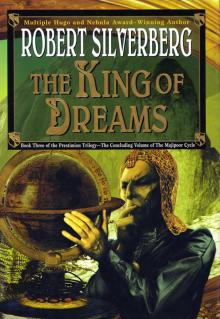 The King of Dreams
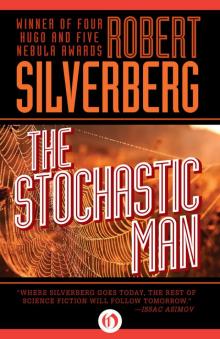 The Stochastic Man
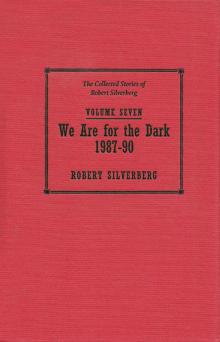 The Collected Stories of Robert Silverberg, Volume Seven: We Are for the Dark
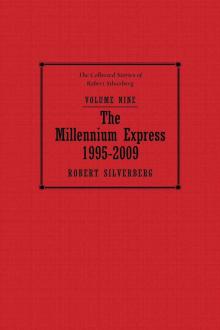 The Millennium Express: The Collected Stories of Robert Silverberg, Volume Nine
 The Iron Chancellor
 Lord Prestimion
 To Open the Sky
 The World Inside
 Chains of the Sea
 The Collected Stories of Robert Silverberg, Volume Five: The Palace at Midnight
 Postmark Ganymede
 The Second Trip
 The Collected Stories of Robert Silverberg, Volume 4: Trips: 1972-73
 Son of Man
 Tom O'Bedlam
 To the Land of the Living
 To Be Continued: The Collected Stories of Robert Silverberg, Volume One
 Shadrach in the Furnace
 The Chalice of Death: Three Novels of Mystery in Space
 The Queen of Springtime
 To Be Continued 1953-1958
 Legends
 Roma Eterna
 To Live Again
 At Winter's End
 Needle in a Timestack
 To Live Again and the Second Trip: The Complete Novels
 Lord of Darkness
 The Mountains of Majipoor
 The World Outside
 The Alien Years
 The Book of Skulls
 The Face of the Waters
 Gilgamesh the King
 The Collected Stories of Robert Silverberg, Volume 6: Multiples: 1983-87
 The Happy Unfortunate
 Three Survived
 Cronos
 Tower of Glass
 Legends II
 The Planet Killers
 The Collected Stories of Robert Silverberg, Volume 2: To the Dark Star: 1962-69
 Downward to the Earth
 Lord Valentine's Castle: Book One of the Majipoor Cycle
 Hot Times in Magma City, 1990-95
 Hunt the Space-Witch! Seven Adventures in Time and Space
 Majipoor Chronicles
 The Robert Silverberg Science Fiction Megapack(r)
 Starman's Quest
 Car Sinister
 Worlds of Maybe
 Fantasy The Best of 2001
 Revolt on Alpha C
 Homefaring
 The Pardoner's Tale
 Sailing to Byzantium - Six Novellas
 The Chalice of Death
 Sundance
 A Tip on a Turtle
 Nebula Awards Showcase 2001: The Year's Best SF and Fantasy Chosen by the Science Fiction and Fantasy Writers of America
 The Fangs of the Trees
 The Palace at Midnight: The Collected Work of Robert Silverberg, Volume Five
 The Millennium Express - 1995-2009 - The Collected Stories of Robert Silverberg Volume Nine
 Book of Skulls
 Passengers
 Something Wild is Loose - 1969–72 - The Collected Stories of Robert Silverberg Volume Three
 Multiples
 Starborne
 The Masks of Time
 The Mountains of Majipoor m-8
 Multiples (1983-87)
 Those Who Watch
 In the Beginning
 Earth Is The Strangest Planet
 Collision Course
 Neutral Planet
 To the Dark Star - 1962–69 - The Collected Stories of Robert Silverberg Volume Two
 Mutants
 Sailing to Byzantium
 When We Went to See the End of the World
 Robert Silverberg The Science Fiction Hall Of Fame Volume One, 1929-1964
 To Be Continued - 1953–58 - The Collected Stories of Robert Silverberg Volume One
 Valentine Pontifex m-3
 Gianni
 Majipoor Chronicles m-2
 We Are for the Dark (1987-90)
 Waiting for the Earthquake
 Fantasy: The Best of 2001
 How It Was When the Past Went Away
 Beauty in the Night
 The Man Who Never Forgot
 The Book of Changes m-9
 Lord Valentine's Castle m-1
 This Way to the End Times
 Queen of Springtime
 Legends-Volume 3 Stories by the Masters of Modern Fantasy
 The Palace at Midnight - 1980–82 - The Collected Stories of Robert Silverberg Volume Five
 Something Wild is Loose: The Collected Stories of Robert Silverberg, Volume Three
 Multiples - 1983–87 - The Collected Stories of Robert Silverberg Volume Six
 Alaree
 Three Survived: A Science Fiction Novel
 Defenders of the Frontier
 The New Springtime
 We Are for the Dark - 1987–90 - The Collected Stories of Robert Silverberg Volume Seven
 The Science Fiction Hall of Fame, Volume One 1929-1964--The Greatest Science Fiction Stories of All Time Chosen by the Members of the Science Fiction Writers of America
 Master Of Life And Death
 Choke Chain
 Sorcerers of Majipoor m-4
 Absolutely Inflexible
 Trips - 1962–73 - The Collected Stories of Robert Silverberg Volume Four
 Hot Times in Magma City - 1990-95 - The Collected Stories of Robert Silverberg Volume Eight
 Far Horizons
 The Queen of Springtime ns-2
 The Seventh Science Fiction Megapack
 Invaders From Earth
 Hanosz Prime Goes To Old Earth
 The Macauley Circuit
 Science Fiction: The Best of 2001
 To the Dark Star: The Collected Stories of Robert Silverberg, Volume Two
 Stochastic Man
 Legends: Stories By The Masters of Modern Fantasy
 To Live Again And The Second Trip
 Flies
Flies The Silent Invaders
 Ship-Sister, Star-Sister