
- Home
- Robert Silverberg
To Open the Sky Page 10
To Open the Sky Read online
Page 10
“What are you doing here?” Martell asked.
“Me? That’s a terribly long story, and not entirely creditable to me. The essence of it is that I was a young fool and let myself get maneuvered into being sent here. That was forty years ago, and I’ve stopped resenting what happened by now. It was the finest thing that could have happened to me in my life, I’ve come to realize, and I suppose it’s a mark of maturity that I was able to see—”
Mondschein’s garrulity irritated the precise-minded Martell. He cut in: “I don’t want your personal history, Brother Mondschein. I meant, how long has your order been here?”
“Close to fifty years.”
“Uninterruptedly?”
“Yes. We have eight shrines here and about four thousand communicants, all of them low-caste. The high casters don’t deign to notice us.”
“They don’t deign to wipe you out, either,” Martell observed.
“True,” said Mondschein. “Perhaps we’re beneath their contempt.”
“But they’ve killed every Vorster missionary who’s ever come here,” Martell said. “Us they devour, you they tolerate. Why is that?”
“Perhaps they see a strength in us that they don’t find in the parent organization,” suggested the heretic. “They admire strength, of course. You must know that, or you’d never have tried to walk from the landing station. You were demonstrating your strength under stress. But of course it would rather have spoiled your demonstration if that Wheel had slashed you to death.”
“As it very nearly did.”
“As it certainly would have done,” said Mondschein, “if I had not happened to notice your predicament. That would have terminated your mission here rather prematurely. Do you like the wine?”
Martell had barely tasted it. “It’s not bad. Tell me, Mondschein, have they really let themselves be converted here?”
“A few. A few.”
“Hard to believe. What do you people know that we don’t?”
“It isn’t what we know,” Mondschein said. “It’s what we have to offer. Come with me into the chapel.”
“I’d rather not.”
“Please. It won’t give you a disease.”
Reluctantly, Martell allowed himself to be led right into the sanctum sanctorum. He looked around with distaste at the ikons, the images, and all the rest of the Harmonist rubbish. At the altar, where a Vorster chapel would have had the tiny reactor emitting blue Cerenkov radiation, there was mounted a gleaming atom-symbol model along which electron-simulacra pulsed in blinding, ceaseless motion. Martell did not think of himself as a bigoted man, but he was loyal to his faith, and the sight of all this childish paraphernalia sickened him.
Mondschein said, “Noel Vorst’s the most brilliant man of our times, and his accomplishments mustn’t be underrated. He saw the culture of Earth fragmented and decadent, saw people everywhere escaping into drug addictions and Nothing Chambers and a hundred other deplorable things. And he saw that the old religions had lost their grip, that the time was ripe for an eclectic, synthetic new creed that dispensed with the mysticism of the former religions and replaced it with a new kind of mysticism, a scientific mysticism. That Blue Fire of his—a wonderful symbol, something to capture the imagination and dazzle the eye, as good as the Cross and the Crescent, even better, because it was modern, it was scientific, it could be comprehended even while it bewildered. Vorst had the insight to establish his cult and the administrative ability to put it across. But has thinking was incomplete.”
“That’s a lofty dismissal, isn’t it? When you consider that we control Earth in a way that no single religious movement of the past has ever—”
Mondschein smiled. “The achievement on Earth is very imposing, I agree. Earth was ready for Vorst’s doctrines. Why did he fail on the other planets, though? Because his thinking was too advanced. He didn’t offer anything that colonists could surrender their hearts and souls to.”
“He offers physical immortality in the present body,” Martell said crisply. “Isn’t that enough?”
“No. He doesn’t offer a mythos. Just a cold quid-pro-quo, come to the chapel and pay your tithe and you can live forever, maybe. It’s a secular religion, despite all the litanies and rituals that have been creeping in. It lacks poetry. There’s no Christ-child in the manger, no Abraham sacrificing Isaac, no spark of humanity, no—”
“No simplistic fairy tales,” said Martell in a brusque tone. “Agreed. That’s the whole point of our teaching. We came into a world no longer capable of believing the old stories, and instead of spinning new ones we offered simplicity, strength, the power of scientific achievement—”
“And took political control of most of the planet, while also establishing magnificent laboratories that carried on advanced research in longevity and esping. Fine. Fine. Admirable. But you failed here. We are succeeding. We have a story to tell, the story of Noel Vorst, the First Immortal, his redemption in the atomic fire, his awakening from sin. We offer our people a chance to be redeemed in Vorst and in the later prophet of Transcendent Harmony, David Lazarus. What we have is something that captures the fancy of the low-casters, and in another generation we’ll have the high-casters, too. These are pioneers, Brother Martell. They’ve cut all ties with Earth, and they’re starting over on their own, in a society just a few generations old. They need myths. They’re shaping myths of their own here. Don’t you think that in another century the first colonists of Venus will be regarded as supernatural beings, Martell? Don’t you think that they’ll be Harmonist saints by then?”
Martell was genuinely startled. “Is that your game?”
“Part of it.”
“All you’re doing is returning to fifth-century Christianity.”
“Not exactly. We’re continuing the scientific work, too.”
“And you believe your own teachings?” Martell asked.
Mondschein smiled strangely. “When I was young,” he said, “I was a Vorster acolyte, at the Nyack chapel. I went into the Brotherhood because it was a job. I needed a structure for my life, and I had a wild hope of being sent out to Santa Fe to become a subject in the immortality experiments, and so I enrolled. For the most unworthy of motives. Do you know, Martell, that I didn’t feel a shred of a religious calling? Not even the Vorster stuff—stripped down, secular—could get to me. Through a series of confusions that I still don’t fully understand and that I won’t even begin to explain to you, I left the Brotherhood and joined the Harmonist movement and came here as a missionary. The most successful missionary ever sent to Venus, as it happens. Do you think the Harmonist mythologies can move me if I was too rational to accept Vorster thinking?”
“So you’re completely cynical in handing out this nonsense about saints and images. You do it for the sake of preserving your power. A peddler of nostrums, a quack preacher in the backwoods of Venus—”
“Easy,” Mondschein warned. “I’m getting results. And, as I think Noel Vorst himself might tell you, we deal in ends, not in means. Would you like to kneel here and pray awhile?”
“Of course not.”
“May I pray for you, then?”
“You just told me you don’t believe your own creed.”
Smiling, Mondschein said, “Even the prayers of an unbeliever may be heard. Who knows? Only one thing is certain: you’ll die here, Martell. So I’ll pray for you, that you may pass through the purifying flame of the higher frequencies.”
“Spare me. Why are you so sure I’ll die here? It’s a fallacy to assume that, simply because all previous Vorster missionaries have been martyred here, I’ll be martyred, too.”
“Our own position is uneasy enough on Venus. Yours will be impossible. Venus doesn’t want you. Shall I tell you the only way you’ll possibly live more than a month here?”
“Do.”
“Join us. Trade in that blue tunic for a green one. We have need for all the capable men we can get.”
“Don’t be absurd. Do you really think I’
d do any such thing?”
“It isn’t beyond possibility. Many men have left your order for mine—myself included.”
“I prefer martyrdom,” Martell said.
“In what way will that benefit anybody? Be reasonable, Brother. Venus is a fascinating place. Wouldn’t you like to live to see a little of it? Join us. You’ll learn the rituals soon enough. You’ll see that we aren’t such ogres. And—”
“Thank you,” said Martell. “Will you excuse me now?”
“I had hoped you would be our guest for dinner.”
“That won’t be possible. I’m expected at the Martian Embassy, if I don’t meet any more local beasts in the road.”
Mondschein looked unruffled by Martell’s rejection of his offer—an offer that could not have been made, Martell thought, in any great degree of seriousness. The older man said gravely, “Allow me, at least, to offer you transportation to town. Surely your pride in your own sanctity will permit you to accept that.”
Martell smiled. “Gladly. It’ll make a good story to tell Coordinator Kirby—how the heretics saved my life and gave me a ride into town.”
“After making an attempt to seduce you from your faith.”
“Naturally. May I leave now?”
“It’ll be a few moments until I can arrange for the car. Would you like to wait outside?”
Martell bowed and made a grateful escape from the heretical chapel. Passing through the building, he emerged into the yard, a cleared space some fifty feet square bordered by scaly, grayish-green shrubbery whose thick-petaled black flowers had an oddly carnivorous look. Four Venusian boys, including Martell’s rescuer, were at work on an excavation. They were using manual tools—shovels and picks—which gave Martell the uncomfortable sensation of having slid back into the nineteenth century. Earth’s gaudy array of gadgetry, so conspicuous and so familiar, could not be found here.
The boys glared coldly at him and went on with their work. Martell watched. They were lean and supple, and he guessed that their ages ranged from about nine to fourteen, though it was hard to tell. They looked enough alike to be brothers. Their movements were graceful, almost elegant, and their bluish skins gleamed lightly with perspiration. It seemed to Martell that the bony structure of their bodies was even more alien than he had thought; they did improbable things with their joints as they worked.
Abruptly, they tossed their picks and shovels aside and joined hands. The bright eyes closed a moment. Martell saw the loose dirt rise from the excavation pit and collect itself in a neat mound some twenty feet behind it.
They’re pushers, Martell thought in wonder. Look at them!
Brother Mondschein appeared at that precise moment. “The car is waiting, Brother,” he said smoothly.
four
AS HE ENTERED the Venusian city, Martell could not take his mind from the casual feat of the four boys. They had scooped a few hundred pounds of loose soil from a pit, using esp abilities, and had smugly deposited it just where they wanted it to go.
Pushers! Martell trembled with barely suppressed excitement. The espers of Earth were a numerous tribe now, but their talents were mainly telepathic, not extending in the direction of telekinesis to any significant degree. Nor could the development of the powers be controlled. A program of scheduled breeding, now in its fourth or fifth generation, was intensifying the existing esp powers. It was possible for a gifted esper to reach into a man’s mind and rearrange its contents, or to probe for the deepest secrets. There were a few precogs, too, who ranged up and down the time sequence as though all points along it were one point, but they usually burned out in adolescence, and their genes were lost to the pool. Pushers—teleports—who could move physical objects from place to place were as rare as phoenixes on Earth. And here were four of them in a Harmonist chapel’s back yard on Venus!
New tensions quivered in Martell. He had made two unexpected discoveries on his first day: the presence of Harmonists on Venus, and the presence of pushers among the Harmonists. His mission had taken on devastating new urgency, suddenly. It was no longer merely a matter of gaining a foothold in an unfriendly world. It was a matter of being outstripped and surpassed by a heresy thought to be in decline.
The car Mondschein had provided dropped Martell off at the Martian Embassy, a blocky little building fronting on the wide plaza that seemed to be the entire town. The Martians had been instrumental in getting Martell to Venus in the first place, and a call on the Ambassador was of priority importance.
The Martians breathed Earth-type air, and they did not care to adapt themselves to Venusian conditions. Once he entered the building, therefore, Martell had to accept a breathing-hood that would protect him against the atmosphere of the planet of his birth.
The Ambassador, Freeman Nat Weiner, was about twice Martell’s age, perhaps even older—close to ninety, even. His frame was powerful, with shoulders so wide they seemed out of proportion to his hips and legs.
Weiner said, “So you’re here. I really thought you had more sense.”
“We’re determined people, Freeman Weiner.”
“So I know. I’ve been studying your ways for a long time.” Weiner’s eyes became remote. “More than sixty years, in fact. I knew your Coordinator Kirby before his conversion—did he ever tell you that?”
“He didn’t mention it,” Martell said. His flesh crept. Kirby had joined the Vorster Brotherhood about twenty years before Martell had been born. To live a century was nothing unusual these days, and Vorst himself was surely into his twelfth or thirteenth decade, but it was chilling all the same to think of such a span of years.
Weiner smiled. “I came to Earth to negotiate a trade deal, and Kirby was my chaperon. He was with the U.N. then. I gave him a hard time. I was a drinker then. Somehow I don’t think he’ll ever forget that night.” His gaze riveted on Martell’s unblinking eyes. “I want you to know, Brother, that I can’t provide any protection for you if you’re attacked. My responsibility extends only to Martian nationals.”
“I understand.”
“My advice is the same as it’s been from the start. Go back to Earth and live to a ripe old age.”
“I can’t do that, Freeman Weiner. I’ve come with a mission to accomplish.”
“Ah, dedication! Wonderful! Where will you build your chapel?”
“On the road leading to town. Perhaps closer to town than the Harmonist place.”
“And where will you stay until it’s built?”
“I’ll sleep in the open.”
“There’s a bird here,” Weiner said. “They call it a shrike. It’s as big as a dog, and its wings look like old leather, and it has a beak like a spear. I once saw it dive from five hundred feet at a man taking a nap in an open field. The beak pinned him to the ground.”
Unperturbed, Martell said, “I survived an encounter with a Wheel today. Perhaps I can dodge a shrike, too. I don’t intend to be frightened away.”
Weiner nodded. “I wish you luck,” he said.
Luck was about all Martell was going to get from the Ambassador, but he was grateful even for that The Martians were cool toward Earth and all it produced, including its religions. They did not actually hate Earthmen, as the Venusians of both castes appeared to do; the Martians were still Earth-like themselves, and not changed creatures whose bond with the mother world was tenuous at best. But the Martians were tough, aggressive frontiersmen who looked out only for themselves. They served as go-betweens for Earth and Venus because there was profit in it; they accepted missionaries from Earth because there was no harm in it. They were tolerant, in their way, but aloof.
Martell left the Martian Embassy and set about his tasks. He had money and he had energy. He could not hire Venusian labor directly, because it would be an act of pollution for a Venusian even of the low caste to work for an Earthman, but it was possible to commission workmen through Weiner. The Martians, naturally, received a fee for serving as agents.
Workmen were hired and a modest chapel w
as erected. Martell set up his pocket-size reactor and readied it for use. Alone in the chapel, he stood in silence as the Blue Fire flickered into glowing life.
Martell had not lost his capacity for awe. He was a worldly man, no mystic, yet the sight of the radiation streaming from the water-shielded reactor worked its magic on him, and he dropped to his knees, touching his forehead in the gesture of submission. He could not carry his religious feeling to the stage of idolatry, as the Harmonists did, but he was not without a sense of the might of the movement to which he had pledged his life.
The first day Martell simply carried out the ceremonies of dedication. On the second and third and fourth he waited hopefully for some low-caster who might be curious enough to enter the chapel. None came.
Martell did not care to seek worshipers, not just yet. He preferred that his converts be voluntary, if possible. The chapel remained empty. On the fifth day it was entered—but only by a frog-like creature ten inches long, armed with wicked little horns on its forehead and delicate, deadly-looking spines that sprouted from its shoulders. Were there no life-forms on this planet that went without armor or weaponry, Martell wondered? He shooed the frog out. It growled at him and lunged at his foot with its horns. Martell drew his foot back barely in time, interposing a chair. The frog stabbed at the wood, sank inch-deep with the left horn; when it withdrew, an iridescent fluid trickled down the leg of the chair, burning a pathway through the wood. Martell had never been attacked by a frog before. On the second try he got the animal out the door without suffering harm. A pretty planet, he thought.
The next day came a more cheering visitor: the boy Elwhit. Martell recognized him as one of the boys who had been teleporting dirt behind the Harmonist place. He appeared from nowhere and said to Martell, “You’ve got Trouble Fungus out there.”
“Is that bad?”
“It kills people. Eats them. Don’t step in it Are you really a religious?”
“I like to think so.”
“Brother Christopher says you shouldn’t be trusted, that you’re a heretic. What’s a heretic?”
 The Longest Way Home
 Hawksbill Station
 A Time of Changes
 This Way to the End Times: Classic Tales of the Apocalypse
 Beyond the Gate of Worlds
 Lord Valentine's Castle
 The Man in the Maze
 Tales of Majipoor
 Time of the Great Freeze
 The Collected Stories of Robert Silverberg, Volume 3: Something Wild Is Loose: 1969-72
 Planet of Death
 Trips: The Collected Stories of Robert Silverberg, Volume Four
 In the Beginning: Tales From the Pulp Era
 Hot Sky at Midnight
 Valentine Pontifex
 Up the Line
 Thorns
 Amanda and the Alien
 Star of Gypsies
 Nightwings
 The Time Hoppers
 Blood on the Mink
 Dying Inside
 The Last Song of Orpheus
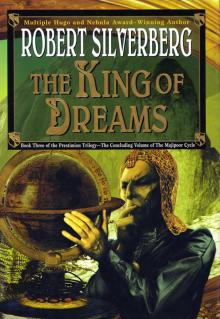 The King of Dreams
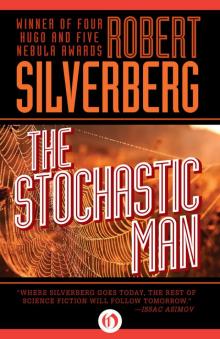 The Stochastic Man
 The Collected Stories of Robert Silverberg, Volume Seven: We Are for the Dark
 The Millennium Express: The Collected Stories of Robert Silverberg, Volume Nine
 The Iron Chancellor
 Lord Prestimion
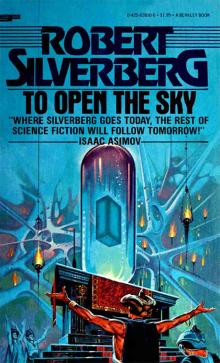 To Open the Sky
 The World Inside
 Chains of the Sea
 The Collected Stories of Robert Silverberg, Volume Five: The Palace at Midnight
 Postmark Ganymede
 The Second Trip
 The Collected Stories of Robert Silverberg, Volume 4: Trips: 1972-73
 Son of Man
 Tom O'Bedlam
 To the Land of the Living
 To Be Continued: The Collected Stories of Robert Silverberg, Volume One
 Shadrach in the Furnace
 The Chalice of Death: Three Novels of Mystery in Space
 The Queen of Springtime
 To Be Continued 1953-1958
 Legends
 Roma Eterna
 To Live Again
 At Winter's End
 Needle in a Timestack
 To Live Again and the Second Trip: The Complete Novels
 Lord of Darkness
 The Mountains of Majipoor
 The World Outside
 The Alien Years
 The Book of Skulls
 The Face of the Waters
 Gilgamesh the King
 The Collected Stories of Robert Silverberg, Volume 6: Multiples: 1983-87
 The Happy Unfortunate
 Three Survived
 Cronos
 Tower of Glass
 Legends II
 The Planet Killers
 The Collected Stories of Robert Silverberg, Volume 2: To the Dark Star: 1962-69
 Downward to the Earth
 Lord Valentine's Castle: Book One of the Majipoor Cycle
 Hot Times in Magma City, 1990-95
 Hunt the Space-Witch! Seven Adventures in Time and Space
 Majipoor Chronicles
 The Robert Silverberg Science Fiction Megapack(r)
 Starman's Quest
 Car Sinister
 Worlds of Maybe
 Fantasy The Best of 2001
 Revolt on Alpha C
 Homefaring
 The Pardoner's Tale
 Sailing to Byzantium - Six Novellas
 The Chalice of Death
 Sundance
 A Tip on a Turtle
 Nebula Awards Showcase 2001: The Year's Best SF and Fantasy Chosen by the Science Fiction and Fantasy Writers of America
 The Fangs of the Trees
 The Palace at Midnight: The Collected Work of Robert Silverberg, Volume Five
 The Millennium Express - 1995-2009 - The Collected Stories of Robert Silverberg Volume Nine
 Book of Skulls
 Passengers
 Something Wild is Loose - 1969–72 - The Collected Stories of Robert Silverberg Volume Three
 Multiples
 Starborne
 The Masks of Time
 The Mountains of Majipoor m-8
 Multiples (1983-87)
 Those Who Watch
 In the Beginning
 Earth Is The Strangest Planet
 Collision Course
 Neutral Planet
 To the Dark Star - 1962–69 - The Collected Stories of Robert Silverberg Volume Two
 Mutants
 Sailing to Byzantium
 When We Went to See the End of the World
 Robert Silverberg The Science Fiction Hall Of Fame Volume One, 1929-1964
 To Be Continued - 1953–58 - The Collected Stories of Robert Silverberg Volume One
 Valentine Pontifex m-3
 Gianni
 Majipoor Chronicles m-2
 We Are for the Dark (1987-90)
 Waiting for the Earthquake
 Fantasy: The Best of 2001
 How It Was When the Past Went Away
 Beauty in the Night
 The Man Who Never Forgot
 The Book of Changes m-9
 Lord Valentine's Castle m-1
 This Way to the End Times
 Queen of Springtime
 Legends-Volume 3 Stories by the Masters of Modern Fantasy
 The Palace at Midnight - 1980–82 - The Collected Stories of Robert Silverberg Volume Five
 Something Wild is Loose: The Collected Stories of Robert Silverberg, Volume Three
 Multiples - 1983–87 - The Collected Stories of Robert Silverberg Volume Six
 Alaree
 Three Survived: A Science Fiction Novel
 Defenders of the Frontier
 The New Springtime
 We Are for the Dark - 1987–90 - The Collected Stories of Robert Silverberg Volume Seven
 The Science Fiction Hall of Fame, Volume One 1929-1964--The Greatest Science Fiction Stories of All Time Chosen by the Members of the Science Fiction Writers of America
 Master Of Life And Death
 Choke Chain
 Sorcerers of Majipoor m-4
 Absolutely Inflexible
 Trips - 1962–73 - The Collected Stories of Robert Silverberg Volume Four
 Hot Times in Magma City - 1990-95 - The Collected Stories of Robert Silverberg Volume Eight
 Far Horizons
 The Queen of Springtime ns-2
 The Seventh Science Fiction Megapack
 Invaders From Earth
 Hanosz Prime Goes To Old Earth
 The Macauley Circuit
 Science Fiction: The Best of 2001
 To the Dark Star: The Collected Stories of Robert Silverberg, Volume Two
 Stochastic Man
 Legends: Stories By The Masters of Modern Fantasy
 To Live Again And The Second Trip
 Flies
Flies The Silent Invaders
 Ship-Sister, Star-Sister