
- Home
- Robert Silverberg
Starman's Quest Page 18
Starman's Quest Read online
Page 18
_Chapter Seventeen_
The old man's diary was a curious and fascinating document. Alan nevertired of poring over it, trying to conjure up a mental image of thequeer, plucky fanatic who had labored so desperately to bring the starsclose to Earth.
Like many embittered recluses, Cavour had been an enthusiastic diarist.Everything that took place in his daily life was carefully noteddown--his digestion, the weather, any stray thoughts that came to him,tart observations on humanity in general. But Alan was chieflyinterested in the notations that dealt with his researches on theproblem of a faster-than-the-speed-of-light spacedrive.
Cavour had worked for years in London, harried by reporters and mockedby scientists. But late in 2569 he had sensed he was on the threshold ofsuccess. In his diary for January 8, 2570, he wrote:
"The Siberian site is almost perfect. It has cost me nearly what remainsof my savings to build it, but out here I will have the solitude I needso much. I estimate six months more will see completion of my pilotmodel. It is a source of deep bitterness in me that I am forced to workon my ship like a common laborer, when my part should have ceased threeyears ago with the development of my theory and the designing of myship. But this is the way the world wants it, and so shall it be."
On May 8 of that year:
"Today there was a visitor--a journalist, no doubt. I drove him awaybefore he could disturb me, but I fear he and others will be back. Evenin the bleak Siberian steppes I shall have no privacy. Work is movingalong smoothly, though somewhat behind schedule; I shall be lucky tocomplete my ship before the end of the year."
On August 17:
"Planes continue to circle my laboratory here. I suspect I am beingspied on. The ship is nearing completion. It will be ready for standardLexman-drive flights any day now, but installation of my spacewarpgenerator will take several more months."
On September 20:
"Interference has become intolerable. For the fifth day an Americanjournalist has attempted to interview me. My 'secret' Siberianlaboratory has apparently become a world tourist attraction. The finalcircuitry on the spacewarp generator is giving me extreme difficulties;there are so many things to perfect. I cannot work under thesecircumstances. I have virtually ceased all machine-work this week."
And on October 11, 2570:
"There is only one recourse for me. I will have to leave Earth tocomplete the installation of my generator. The prying fools and mockerswill not leave me alone, and nowhere on Earth can I have the neededsolitude. I shall go to Venus--uninhabited, uninhabitable. Perhaps theywill leave me alone for the month or two more I need to make my vesselsuitable for interstellar drive. Then I can return to Earth, show themwhat I have done, offer to make a demonstration flight--to Rigel andback in days, perhaps----
"Why is it that Earth so tortures its few of original mind? Why has mylife been one unending persecution, ever since I declared there was away to shortcut through space? There are no answers. The answers liedeep within the dark recesses of the human collective soul, and no manmay understand what takes place there. I am content to know that I shallhave succeeded despite it all. Some day a future age may remember me,like Copernicus, like Galileo, as one who fought upstream successfully."
The diary ended there. But in the final few pages were computations--atrial orbit to Venus, several columns of blastoff figures, statistics ongeographical distribution of the Venusian landmasses.
Cavour had certainly been a peculiar bird, Alan thought. Probably halfthe "persecutions" he complained of had existed solely inside his ownfevered brain. But that hardly mattered. He had gone to Venus; the diarythat had found its way back to the London Institute of Technologytestified to that. And there was only one logical next step for Alan.
Go to Venus. Follow the orbit Cavour had scribbled at the back of hisdiary.
Perhaps he might find the Cavour ship itself; perhaps, the site of hislaboratory, some notes, anything at all. He could not allow the trail totrickle out here.
He told Jesperson, "I want to buy a small spaceship. I'm going toVenus."
He looked at the lawyer expectantly and got ready to put up a stiffargument when Jesperson started to raise objections. But the big manonly smiled.
"Okay," he said. "When are you leaving?"
"You aren't going to complain? The kind of ship I have in mind costs atleast two hundred thousand credits."
"I know that. But I've had a look at Cavour's diary, too. It was only amatter of time before you decided to follow the old duck to Venus, andI'm too smart to think that there's any point in putting up a battle.Let me know when you've got your ship picked out and I'll sit down andwrite the check."
But it was not as simple as all that. Alan shopped for a ship--he wanteda new one, as long as he could afford it--and after several months ofcomparative shopping and getting advice from spaceport men, he pickedthe one he wanted. It was a sleek glossy eighty-foot job, a Spacemaster3878 model, equipped with Lexman converters and conventional ion-jetsfor atmosphere flying. Smooth, streamlined, it was a lovely sight as itstood at the spacefield in the shadow of the great starships.
Alan looked at it with pride--a slender dark-green needle yearning topierce the void. He wandered around the spaceport and heard the fuelersand oilers discussing it in reverent tones.
"That's a mighty fine piece of ship, that green one out there. Somelucky fellow's got it."
Alan wanted to go over to them and tell them, "That's my ship. Me. AlanDonnell." But he knew they would only laugh. Tall boys not quitenineteen did not own late-model Spacemasters with price-tags of cr.225,000.
He itched to get off-planet with it, but there were more delays. Heneeded a flight ticket, first, and even though he had had the necessarygrounding in astrogation technique and spacepiloting as an automaticpart of his education aboard the _Valhalla_, he was rusty, and needed arefresher course that took six weary months.
After that came the physical exams and the mental checkup and everythingelse. Alan fumed at the delay, but he knew it was necessary. Aspaceship, even a small private one, was a dangerous weapon in unskilledhands. An out-of-control spaceship that came crashing to Earth at highvelocity could kill millions; the shock wave might flatten fifty squaremiles. So no one was allowed up in a spaceship of any kind without aflight ticket--and you had to work to win your ticket.
It came through, finally, in June of 3879, a month after Alan'stwentieth birthday. By that time he had computed and recomputed hisorbit to Venus a hundred different times.
Three years had gone by since he last had been aboard a spaceship, andthat had been the _Valhalla_. His childhood and adolescence now seemedlike a hazy dream to him, far in the back of his mind. The _Valhalla_,with his father and Steve and all the friends of his youth aboard, wasthree years out from Earth--with seven years yet to go before it reachedProcyon, its destination.
Of course, the Crew had experienced only about four weeks, thanks to theFitzgerald Contraction. To the _Valhalla_ people only a month had passedsince Alan had left them, while he had gone through three years.
He had grown up, in those three years. He knew where he was heading,now, and nothing frightened him. He understood people. And he had onegreat goal which was coming closer and closer with each passing month.
Blastoff day was the fifth of September, 3879. The orbit Alan finallysettled on was a six-day trip at low acceleration across the40,000,000-odd miles that separated Earth from Venus.
At the spaceport he handed in his flight ticket for approval, placed acopy of his intended orbit on file with Central Routing Registration,and got his field clearance.
The ground crew had already been notified that Alan's ship was blastingoff that day, and they were busy now putting her in final departurecondition. There were some expressions of shock as Alan displayed hiscredentials to the ground chief and climbed upward into the controlchamber of the ship he had named the _James Hudson Cavour_, but no onedared question him.
His eyes caressed the gleaming furnishings of th
e control panel. Hechecked with the central tower, was told how long till his blastoffclearance, and rapidly surveyed the fuel meters, the steering-jetresponse valves, the automatic pilot. He worked out a tape with hisorbit on it. Now he inserted it into the receiving tray of the autopilotand tripped a lever. The tape slid into the computer, clicking softlyand emitting a pleasant hum.
"Eight minutes to blastoff," came the warning.
Never had eight minutes passed so slowly. Alan snapped on his viewscreenand looked down at the field; the ground crew men were busily clearingthe area as blastoff time approached.
"One minute to blastoff, Pilot Donnell." Then the count-down began,second by second.
At the ten-seconds-to-go announcement, Alan activated the autopilot andnudged the button that transformed his seat into a protectiveacceleration cradle. His seat dropped down, and Alan found himselfstretched out, swinging gently back and forth in the protecting hammock.The voice from the control tower droned out the remaining seconds.Tensely Alan waited for the sharp blow of acceleration.
Then the roaring came, and the ship jolted from side to side, struggledwith gravity for a moment, and then sprang up free from the Earth.
Some time later came the sudden thunderous silence as the jets cut out;there was the dizzying moment of free fall, followed by the sound of thelateral jets imparting longitudinal spin to the small ship. Artificialgravity took over. It had been a perfect takeoff. Now there was nothingto do but wait for Venus to draw near.
The days trickled past. Alan experienced alternating moods of gloom andexultation. In the gloomy moods he told himself that this trip to Venuswas a fool's errand, that it would be just another dead end, that Cavourhad been a paranoid madman and the hyperspace drive was an idiot'sdream.
But in the moments of joy he pictured the finding of Cavour's ship, thebuilding of a fleet of hyperdrive vessels. The distant stars withinalmost instantaneous reach! He would tour the galaxies as he had twoyears ago toured Earth. Canopus and Deneb, Rigel and Procyon, he wouldvisit them all. From star to bright star, from one end of the universeto the other.
The shining oval of Venus grew brighter and brighter. The cloud layerthat enveloped Earth's sister planet swirled and twisted.
Venus was virtually an unknown world. Earth colonies had beenestablished on Mars and on Pluto, but Venus, with her harshformaldehyde atmosphere, had been ignored. Uninhabited, uninhabitable,the planet was unsuitable for colonization.
The ship swung down into the cloud layer; floating wisps of gray vaporstreamed past the orbiting _Cavour_. Finally Alan broke through,navigating now on manual, following as best he could Cavour's oldcomputations. He guided the craft into a wide-ranging spiral orbit threethousand feet above the surface of Venus, and adjusted his viewscreensfor fine pickup.
He was orbiting over a vast dust-blown plain. The sky was a fantasticcolor, mottled blues and greens and an all-pervading pink, and the airwas dull gray. No sun at all penetrated the heavy shroud of vapor thathung round the planet.
For five hours he scouted the plain, hoping to find some sign ofCavour's habitation. It was hopeless, he told himself; in thirteenhundred years the bitter winds of Venus would have destroyed any hint ofCavour's site, assuming the old man had reached Venus successfully.
But grimly Alan continued to circle the area. Maybe Cavour had beenforced to land elsewhere, he thought. Maybe he never got here. Therewere a million maybes.
He computed his orbit and locked the ship in. Eyes pressed to theviewscreen, he peered downward, hoping against hope.
This trip to Venus had been a wild gamble from the start. He wondered ifMax Hawkes would have covered a bet on the success of his trip. Max hadbeen infallible when it came to hunches.
_Well_, Alan thought, _now I've got a hunch. Help me one more time, Max,wherever you are! Lend me some of your luck. I need it, Max._
He circled once more. The Venusian day would last for three weeks more;there was no fear of darkness. But would he find anything?
_What's that?_
He leaped to the controls, switched off the autopilot, and broke out oforbit, going back for a return look. Had there been just the faintestmetallic glint below, as of a spaceship jutting up from the sand?
Yes.
There was a ship down there, and a cave of some sort. Alan feltstrangely calm. With confident fingers he punched out a landing orbit,and brought his ship down in the middle of the barren Venusian desert.
 The Longest Way Home
 Hawksbill Station
 A Time of Changes
 This Way to the End Times: Classic Tales of the Apocalypse
 Beyond the Gate of Worlds
 Lord Valentine's Castle
 The Man in the Maze
 Tales of Majipoor
 Time of the Great Freeze
 The Collected Stories of Robert Silverberg, Volume 3: Something Wild Is Loose: 1969-72
 Planet of Death
 Trips: The Collected Stories of Robert Silverberg, Volume Four
 In the Beginning: Tales From the Pulp Era
 Hot Sky at Midnight
 Valentine Pontifex
 Up the Line
 Thorns
 Amanda and the Alien
 Star of Gypsies
 Nightwings
 The Time Hoppers
 Blood on the Mink
 Dying Inside
 The Last Song of Orpheus
 The King of Dreams
 The Stochastic Man
 The Collected Stories of Robert Silverberg, Volume Seven: We Are for the Dark
 The Millennium Express: The Collected Stories of Robert Silverberg, Volume Nine
 The Iron Chancellor
 Lord Prestimion
 To Open the Sky
 The World Inside
 Chains of the Sea
 The Collected Stories of Robert Silverberg, Volume Five: The Palace at Midnight
 Postmark Ganymede
 The Second Trip
 The Collected Stories of Robert Silverberg, Volume 4: Trips: 1972-73
 Son of Man
 Tom O'Bedlam
 To the Land of the Living
 To Be Continued: The Collected Stories of Robert Silverberg, Volume One
 Shadrach in the Furnace
 The Chalice of Death: Three Novels of Mystery in Space
 The Queen of Springtime
 To Be Continued 1953-1958
 Legends
 Roma Eterna
 To Live Again
 At Winter's End
 Needle in a Timestack
 To Live Again and the Second Trip: The Complete Novels
 Lord of Darkness
 The Mountains of Majipoor
 The World Outside
 The Alien Years
 The Book of Skulls
 The Face of the Waters
 Gilgamesh the King
 The Collected Stories of Robert Silverberg, Volume 6: Multiples: 1983-87
 The Happy Unfortunate
 Three Survived
 Cronos
 Tower of Glass
 Legends II
 The Planet Killers
 The Collected Stories of Robert Silverberg, Volume 2: To the Dark Star: 1962-69
 Downward to the Earth
 Lord Valentine's Castle: Book One of the Majipoor Cycle
 Hot Times in Magma City, 1990-95
 Hunt the Space-Witch! Seven Adventures in Time and Space
 Majipoor Chronicles
 The Robert Silverberg Science Fiction Megapack(r)
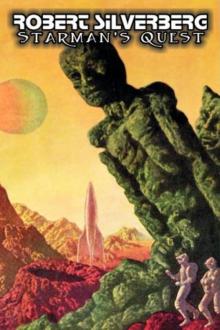 Starman's Quest
 Car Sinister
 Worlds of Maybe
 Fantasy The Best of 2001
 Revolt on Alpha C
 Homefaring
 The Pardoner's Tale
 Sailing to Byzantium - Six Novellas
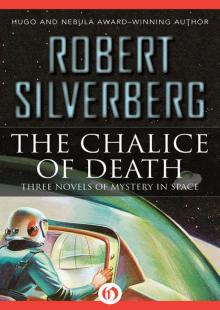 The Chalice of Death
 Sundance
 A Tip on a Turtle
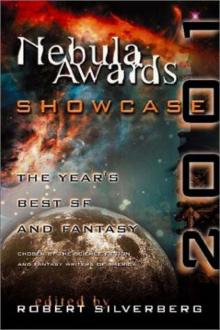 Nebula Awards Showcase 2001: The Year's Best SF and Fantasy Chosen by the Science Fiction and Fantasy Writers of America
 The Fangs of the Trees
 The Palace at Midnight: The Collected Work of Robert Silverberg, Volume Five
 The Millennium Express - 1995-2009 - The Collected Stories of Robert Silverberg Volume Nine
 Book of Skulls
 Passengers
 Something Wild is Loose - 1969–72 - The Collected Stories of Robert Silverberg Volume Three
 Multiples
 Starborne
 The Masks of Time
 The Mountains of Majipoor m-8
 Multiples (1983-87)
 Those Who Watch
 In the Beginning
 Earth Is The Strangest Planet
 Collision Course
 Neutral Planet
 To the Dark Star - 1962–69 - The Collected Stories of Robert Silverberg Volume Two
 Mutants
 Sailing to Byzantium
 When We Went to See the End of the World
 Robert Silverberg The Science Fiction Hall Of Fame Volume One, 1929-1964
 To Be Continued - 1953–58 - The Collected Stories of Robert Silverberg Volume One
 Valentine Pontifex m-3
 Gianni
 Majipoor Chronicles m-2
 We Are for the Dark (1987-90)
 Waiting for the Earthquake
 Fantasy: The Best of 2001
 How It Was When the Past Went Away
 Beauty in the Night
 The Man Who Never Forgot
 The Book of Changes m-9
 Lord Valentine's Castle m-1
 This Way to the End Times
 Queen of Springtime
 Legends-Volume 3 Stories by the Masters of Modern Fantasy
 The Palace at Midnight - 1980–82 - The Collected Stories of Robert Silverberg Volume Five
 Something Wild is Loose: The Collected Stories of Robert Silverberg, Volume Three
 Multiples - 1983–87 - The Collected Stories of Robert Silverberg Volume Six
 Alaree
 Three Survived: A Science Fiction Novel
 Defenders of the Frontier
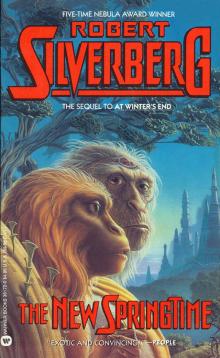 The New Springtime
 We Are for the Dark - 1987–90 - The Collected Stories of Robert Silverberg Volume Seven
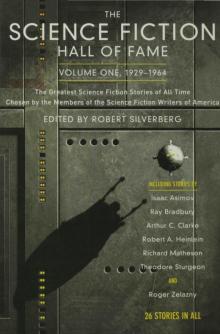 The Science Fiction Hall of Fame, Volume One 1929-1964--The Greatest Science Fiction Stories of All Time Chosen by the Members of the Science Fiction Writers of America
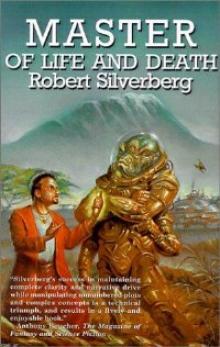 Master Of Life And Death
 Choke Chain
 Sorcerers of Majipoor m-4
 Absolutely Inflexible
 Trips - 1962–73 - The Collected Stories of Robert Silverberg Volume Four
 Hot Times in Magma City - 1990-95 - The Collected Stories of Robert Silverberg Volume Eight
 Far Horizons
 The Queen of Springtime ns-2
 The Seventh Science Fiction Megapack
 Invaders From Earth
 Hanosz Prime Goes To Old Earth
 The Macauley Circuit
 Science Fiction: The Best of 2001
 To the Dark Star: The Collected Stories of Robert Silverberg, Volume Two
 Stochastic Man
 Legends: Stories By The Masters of Modern Fantasy
 To Live Again And The Second Trip
 Flies
Flies The Silent Invaders
 Ship-Sister, Star-Sister